

 Facebook
 X
X
 Pinterest
 Copy Link
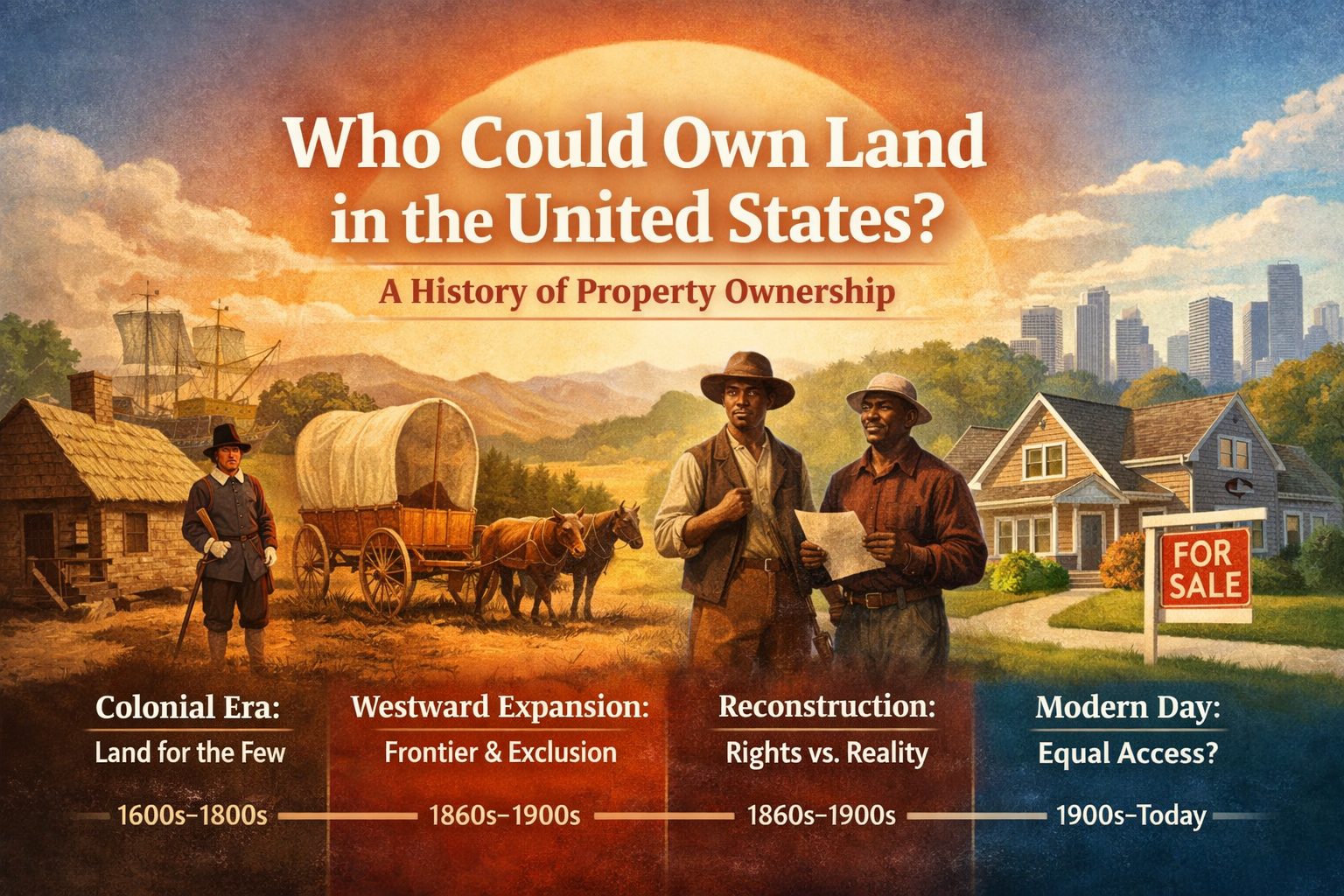
Who Could Own Land in the United States? A Brief History of Property Ownership
Land ownership has always been tied to power, wealth, and opportunity in the United States. But the right to own land hasn’t always been universal. Over the centuries, laws and social norms determined who could—and could not—own property, shaping today’s real estate landscape.
Here’s a timeline of how land ownership evolved throughout U.S. history.
Colonial America (1600s–1776): Land for the Few
In early America, land ownership was largely reserved for:
- White European men
- Wealthy settlers
- Landowners approved by the Crown or colonial governments
Key limitations:
- Women generally could not own land independently
- Enslaved people were considered property, not owners
- Indigenous tribes were displaced through treaties and force
- Religious minorities sometimes faced restrictions
Land was power—and power was tightly controlled.
Post-Revolutionary Era (1776–1820s): Ownership Expands, Slowly
After independence, land ownership broadened, but not equally.
Who could own land:
- White male citizens
- Some immigrant men after naturalization
- Widows in limited circumstances
Still excluded:
- Women (unless widowed)
- Native Americans
- Enslaved Africans
- Free Black Americans in many states
Property ownership often determined voting rights, reinforcing its importance.
Jacksonian Era & Westward Expansion (1820s–1860s): More Access, More Displacement
As the U.S. expanded west:
- Property requirements for voting were dropped
- Small landholdings became more common
- Homesteading encouraged settlement
However:
- Native Americans were forcibly removed from ancestral lands
- Enslaved people remained barred from ownership
- Free Black landowners faced legal and violent barriers
- Women still lacked full property rights
Land was available—but not for everyone.
Post-Civil War & Reconstruction (1865–1900): Legal Rights vs. Reality
The Civil War ended slavery, and new amendments promised equality.
Legal changes:
- Enslaved people were freed
- Black Americans could legally own land
- The Homestead Act allowed citizens to claim land
Practical barriers remained:
- Discriminatory laws and practices
- Sharecropping and debt systems
- Violence and intimidation
- Women’s property rights varied by state
Ownership was legal—but often unreachable.
Early 20th Century (1900–1940s): Segregation and Redlining
During this era:
- Women increasingly gained property rights
- Immigrants could own land after citizenship
But new obstacles emerged:
- Racial covenants barred minorities from buying in many neighborhoods
- Redlining denied loans to minority communities
- Asian immigrants faced land ownership bans in some states
Government-backed policies reinforced inequality in housing.
Post-World War II (1945–1960s): Opportunity for Some
The housing boom transformed America.
Expanded access for:
- White middle-class families
- Veterans using VA loans
Still excluded or restricted:
- Black Americans
- Hispanic and Indigenous families
- Women needing a male co-signer
Suburban growth created generational wealth—but unevenly.
Civil Rights Era (1960s–1980s): Equal Rights Under the Law
Major breakthroughs:
- Fair Housing Act of 1968
- Ban on discrimination based on race, color, religion, or national origin
- Later protections for gender, disability, and family status
For the first time, land ownership was legally open to all Americans.
Modern Era (1990s–Today): Ownership with New Debates
Today:
- Any U.S. citizen can own land
- Non-citizens can generally own property
- Women and minorities own property nationwide
Ongoing discussions include:
- Foreign ownership of U.S. land
- Corporate investors buying residential property
- Affordability and access to housing
While laws now allow broad ownership, economic barriers still shape who buys land.
Why This History Matters in Real Estate Today
Understanding who could own land—and who couldn’t—helps explain:
- Wealth gaps between generations
- Neighborhood development patterns
- Homeownership rates across communities
- Why fair housing laws exist
Modern real estate isn’t just about location and price—it’s built on centuries of policy decisions.
Final Thoughts
Land ownership in the United States has evolved from a privilege reserved for a few to a right legally available to many. While progress has been made, history continues to influence today’s real estate market.
Knowing where we came from helps us better understand where the market—and property ownership—is headed.
Steve Cardinalli
Real Estate Professional, 01323509
(760) 814-0248
Steve@Cardinalli.com
www.Cardinalli.com
Century 21 Affiliated Fine Homes & Estates
Village Faire in Carlsbad Village
300 Carlsbad Village Dr, 223
Carlsbad, CA 92008
Be the first to know about the market trend in your community at Neighborhood News


