

 Facebook
 X
X
 Pinterest
 Copy Link

How the U.S.–Iran Conflict May Influence U.S. Real Estate Prices in 2026
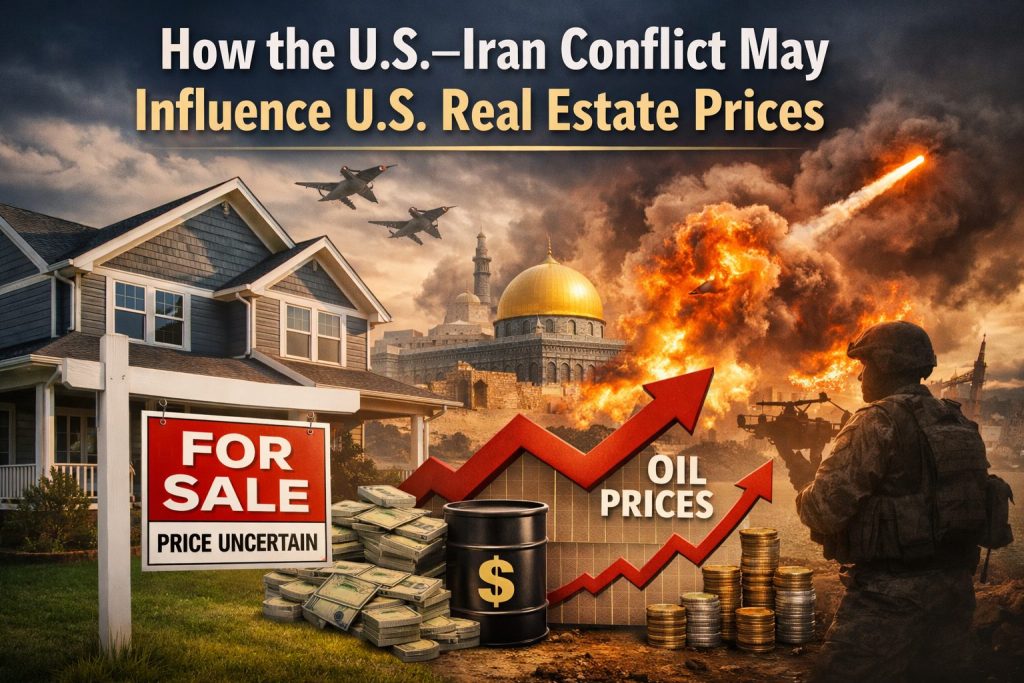 Geopolitical events rarely occur in an economic vacuum — and the ongoing U.S. and allied military action against Iran has already sent ripples across global markets and investor sentiment. On February 28, 2026, U.S. and Israeli forces launched strikes targeting Iran’s leadership and military infrastructure, and Iran has retaliated with missile launches across the region. The situation has escalated to a broader Middle East confrontation with implications for global oil prices, economic confidence, and financial markets.
So what does this mean for U.S. real estate prices?
📈 1. Mortgage Rates & Borrowing Costs Could Rise
One of the most direct ways geopolitical upheaval affects real estate is through interest rates:
- Tensions tend to spike oil prices, which can fuel inflation. Higher inflation often leads the Federal Reserve to maintain or raise interest rates to dampen price increases.
- Higher rates translate into higher mortgage costs, reducing buyer affordability — especially at the entry-level or for first-time buyers.
Bottom line: If inflationary pressures persist, expect mortgage rates to stay elevated longer, which could cool price growth in some housing markets.
📉 2. Investor Sentiment & Capital Flows Shift
When major conflicts break out, markets become risk-averse:
- Investors often flee to “safe havens” like gold and government bonds, and away from higher-risk assets like commercial real estate or speculative housing investments.
- Global uncertainty can slow foreign investment into U.S. property — a segment that has helped sustain prices in gateway cities.
This hesitation can dampen speculative demand, especially in luxury and commercial sectors.
🛢️ 3. Energy Markets & Consumer Budgets Impact
Iran plays a strategic role in global oil flow, including through the Strait of Hormuz. Any conflict that risks disrupting exports could lead to higher energy prices — which have a cascading impact:
- Higher gasoline and heating costs squeeze household budgets.
- More of a buyer’s monthly income goes to essentials, reducing what they can afford for housing.
For real estate professionals, this means affordability metrics — already tight in many regions — could get even tighter if energy prices surge.
🧨 4. Regional Differences in Real Estate Demand
Not all markets react the same during uncertainty:
✅ Resilient Markets
- Stable, high-demand areas with strong job markets (e.g., tech hubs, Sun Belt cities).
- Multifamily and rental markets that benefit from scarcity of homeownership affordability.
⚠️ More Vulnerable Markets
- High-end luxury segments where investor demand is a bigger price driver.
- Hospitality and retail real estate, which are more sensitive to economic slowdowns.
Put simply: core residential markets may withstand pressure better than riskier commercial sectors.
🏠 5. What U.S. Buyers & Sellers Should Watch
Here are proactive insights for your audience:
📍 Buyers:
- Lock in today’s rates if affordability is a concern — don’t assume rates will fall quickly just because of uncertainty.
- Focus on fundamentals: job growth, local demand, and population trends matter more than global headlines.
📍 Sellers:
- Price homes competitively — fear can keep buyers on the sidelines.
- Highlight value drivers like low local inventory, school districts, and walkability.
📍 Investors:
- Diversify portfolios; consider stable cash-flow assets like multifamily or logistics properties.
- Be cautious with highly leveraged purchases until volatility subsides.
🧠 Putting It All Together
While wars and geopolitical tensions can rattle markets, the U.S. housing market isn’t likely to “crash” solely because of the attack on Iran. Real estate is deeply tied to domestic fundamentals — employment, wages, lending standards — which remain strong in many parts of the U.S.
However, short-term volatility, higher mortgage rates, and investor caution are realistic scenarios that could slow price growth or shift demand between segments.
For real estate pros and consumers alike, the key is differentiating emotion from economics: global uncertainty influences confidence and money flows, but local market dynamics ultimately set prices.
Steve Cardinalli
Real Estate Professional, 01323509
(760) 814-0248
Steve@Cardinalli.com
www.Cardinalli.com
Century 21 Affiliated Fine Homes & Estates
Village Faire in Carlsbad Village
300 Carlsbad Village Dr, 223
Carlsbad, CA 92008
Be the first to know about the market trend in your community at Neighborhood News


