

 Facebook
 X
 Pinterest
 Copy Link
The Importance of a Closet:
More Than Just a Place to Store Your Clothes
When people think about the features that make a home appealing, they often focus on kitchens, bathrooms, flooring, or outdoor living spaces. But there is another feature that can have a surprisingly significant impact on how comfortable and functional a home feels: the closet.
A well-designed closet provides much more than storage. It can help keep a home organized, make bedrooms feel larger, improve everyday convenience, and even influence a buyer’s perception of a property’s overall functionality.
Whether you’re buying, selling, or remodeling a home, understanding the different types of closets and the features available can help you make better real estate decisions.
Why Closets Matter in Real Estate
Storage is one of the most frequently considered features when buyers evaluate a home. A property may have beautiful finishes, but insufficient storage can become a major drawback after a buyer moves in.
Closets can provide:
- Convenient clothing storage
- Additional household storage
- Better organization
- Reduced clutter
- Improved use of bedroom space
- Dedicated storage for shoes and accessories
- Space for linens and towels
- Storage for seasonal items
- Better functionality for families
In today’s homes, buyers increasingly expect storage to be both abundant and well organized.
Common Types of Closets
Reach-In Closet
The reach-in closet is one of the most common closet designs. It typically extends along one wall and is accessed through sliding, bifold, or hinged doors.
A well-designed reach-in closet can include:
- Adjustable shelving
- Clothing rods at different heights
- Shoe racks
- Drawers
- Built-in cabinets
- Accessory storage
Although reach-in closets are generally smaller than walk-in closets, thoughtful organization can make them extremely efficient.
Walk-In Closet
A walk-in closet provides enough space for a person to enter the storage area. These closets can range from relatively compact spaces to large, luxurious dressing rooms.
Features may include:
- Multiple clothing rods
- Built-in drawers
- Shelving
- Shoe displays
- Jewelry storage
- Mirrors
- Seating
- Islands
- Built-in lighting
For many buyers, a large primary bedroom walk-in closet is a highly desirable feature.
Primary Suite Closet
Modern primary suites frequently include one or more dedicated closets. Larger homes may feature separate closets for each person, sometimes referred to as his-and-hers closets or dual walk-in closets.
Separate closets can provide additional organization and eliminate competition for storage space.
Linen Closet
A linen closet is designed primarily for household linens such as:
- Towels
- Sheets
- Blankets
- Pillowcases
- Cleaning supplies
Linen closets are often located near bedrooms or bathrooms, where their contents are most frequently used.
Coat Closet
Usually located near the home’s entry, a coat closet provides convenient storage for:
- Jackets
- Coats
- Hats
- Shoes
- Umbrellas
- Bags
An entry closet can help keep everyday items from accumulating near the front door.
Pantry Closet
Although technically not a traditional clothing closet, a pantry serves a similar purpose: organized storage.
A well-designed pantry can include adjustable shelving, pull-out drawers, appliance storage, and dedicated areas for food and kitchen supplies.
Utility or Storage Closet
Utility closets provide storage for items that don’t necessarily belong in living areas. They may be used for:
- Vacuums
- Brooms
- Mops
- Cleaning products
- Household tools
- Seasonal decorations
These spaces can be especially valuable in smaller homes where garage and attic storage may be limited.
Mudroom Closet
Homes with mudrooms may incorporate dedicated storage for coats, shoes, backpacks, sports equipment, and other frequently used items.
A mudroom closet can be particularly useful for families with children.
Closet Features That Add Functionality
The size of a closet is important, but how the space is designed can be just as important.
Built-In Shelving
Built-in shelving allows homeowners to take advantage of vertical space and keep items organized.
Double-Hanging Rods
Two clothing rods can dramatically increase hanging capacity by allowing shorter garments to be stored above and below.
Drawers
Built-in drawers provide convenient storage for folded clothing, accessories, and smaller items while keeping everything out of sight.
Shoe Storage
Dedicated shoe racks, shelves, or cubbies can prevent footwear from taking over the floor.
Adjustable Shelving
Adjustable shelves allow homeowners to change the configuration as their storage needs change.
Closet Islands
Large walk-in closets may accommodate a center island containing drawers and additional storage. Islands can also provide a convenient surface for folding clothing.
Lighting
Good lighting can make a closet significantly more functional. Options can include recessed lighting, pendant fixtures, LED strips, and motion-activated lighting.
A dark closet can make it difficult to find clothing and accessories, while good lighting makes the space feel more inviting and usable.
Mirrors
A full-length mirror can be particularly useful in a dressing-oriented walk-in closet.
Soft-Close Hardware
Modern closet systems may include soft-close drawers and doors, providing a more refined feel.
Custom Organization Systems
Custom closet systems can combine shelving, rods, drawers, shoe storage, and accessories into a single coordinated design.
Vintage Style and Closet Design
Closets don’t have to be strictly modern to be functional. Vintage furniture and accessories can add personality while providing creative storage solutions.
For homeowners who enjoy vintage style, incorporating pieces such as antique dressers, armoires, trunks, baskets, or unique storage accessories can transform an ordinary closet or dressing area into something distinctive.
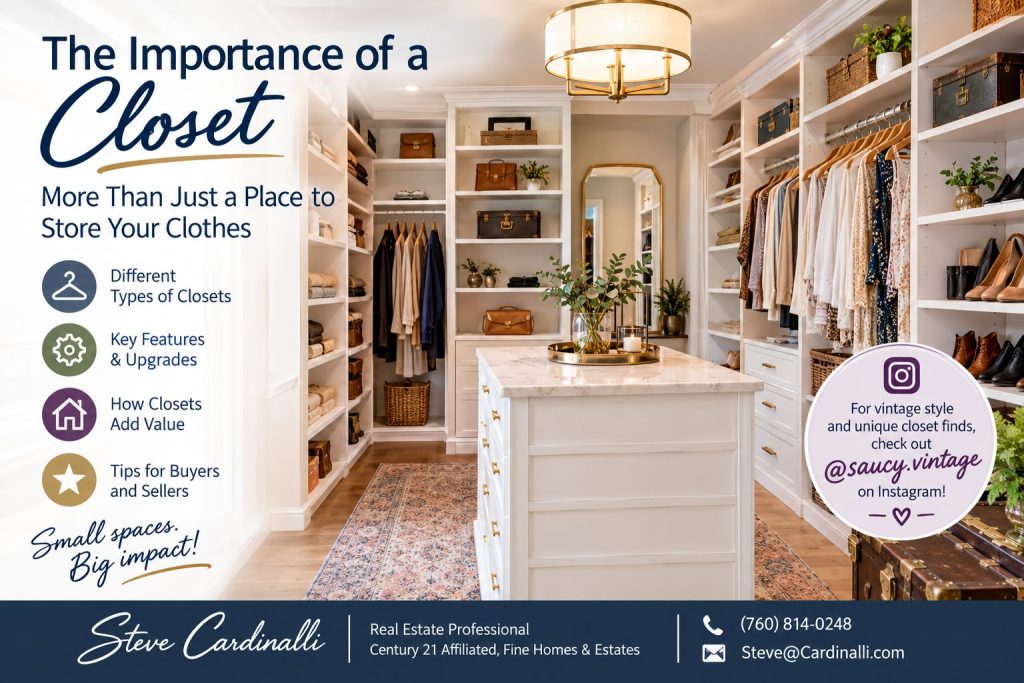
For vintage clothing inspiration and unique pieces to add to your closet, check out @saucy.vintage on Instagram.
Closet Size Isn’t Everything
A common misconception is that bigger always means better.
A large closet with poor organization may actually be less useful than a smaller closet that has been carefully designed.
For example, a 6-foot-wide reach-in closet with double rods, shelving, drawers, and shoe storage may provide excellent functionality. Meanwhile, a larger but poorly configured closet may contain significant unused space.
Efficient design is often more important than simply adding square footage.
Closets and Home Buyers
When buyers tour a property, they often open closets. They’re trying to determine whether their belongings will fit comfortably into the home.
Closets can also provide buyers with clues about the overall functionality of a property.
A home with well-organized storage may feel:
- Larger
- Cleaner
- More functional
- Better maintained
- Easier to live in
On the other hand, overstuffed closets can make a home feel smaller and may suggest that the property lacks adequate storage.
Preparing Closets Before Selling
If you’re preparing to sell your home, closets deserve attention just like kitchens and bathrooms.
Consider:
- Remove unnecessary items.
- Donate or dispose of things you no longer use.
- Organize clothing by type or season.
- Remove excess items from closet floors.
- Clean shelves and floors.
- Use matching or coordinated hangers.
- Improve lighting where practical.
- Consider adding inexpensive organizational features.
- Avoid overfilling the closet.
- Make the available storage space easy for buyers to see.
The goal isn’t necessarily to make the closet look empty. The goal is to make it look spacious, organized, and useful.
Do Closets Add Value to a Home?
Closets can contribute to a home’s appeal, but there isn’t a simple dollar-for-dollar value assigned to a particular closet.
A closet’s contribution to marketability can depend on factors such as:
- Location
- Home size
- Bedroom count
- Overall storage capacity
- Neighborhood expectations
- Quality of construction
- Closet design
- Buyer preferences
- Competing properties
A luxurious custom walk-in closet may be expected in some higher-end homes, while a basic reach-in closet may be perfectly appropriate for another property.
From a real estate perspective, the important question isn’t simply “How big is the closet?” It’s “How well does the storage meet the expectations of the market?”
The Bottom Line
Closets may not receive the same attention as kitchens or bathrooms, but they play an important role in how a home functions and how buyers perceive the property.
From a simple coat closet to a custom-designed primary suite dressing room, the right storage can make everyday life easier and help a home stand out.
Good closet design isn’t just about storing more things—it’s about making better use of the space you already have.
If you’re considering buying, selling, or improving a home in San Diego County, understanding how storage and other features affect a property’s marketability can be an important part of the real estate decision-making process.
Steve Cardinalli
Real Estate Professional, 01323509
(760) 814-0248
Steve@Cardinalli.com
www.Cardinalli.com
Century 21 Affiliated Fine Homes & Estates
Village Faire in Carlsbad Village
300 Carlsbad Village Dr, 223
Carlsbad, CA 92008


