

 Facebook
 X
 Pinterest
 Copy Link

ARTICLE 3 of 4:
California Proposition 43 — What Homeowners Should Know About Local Taxes
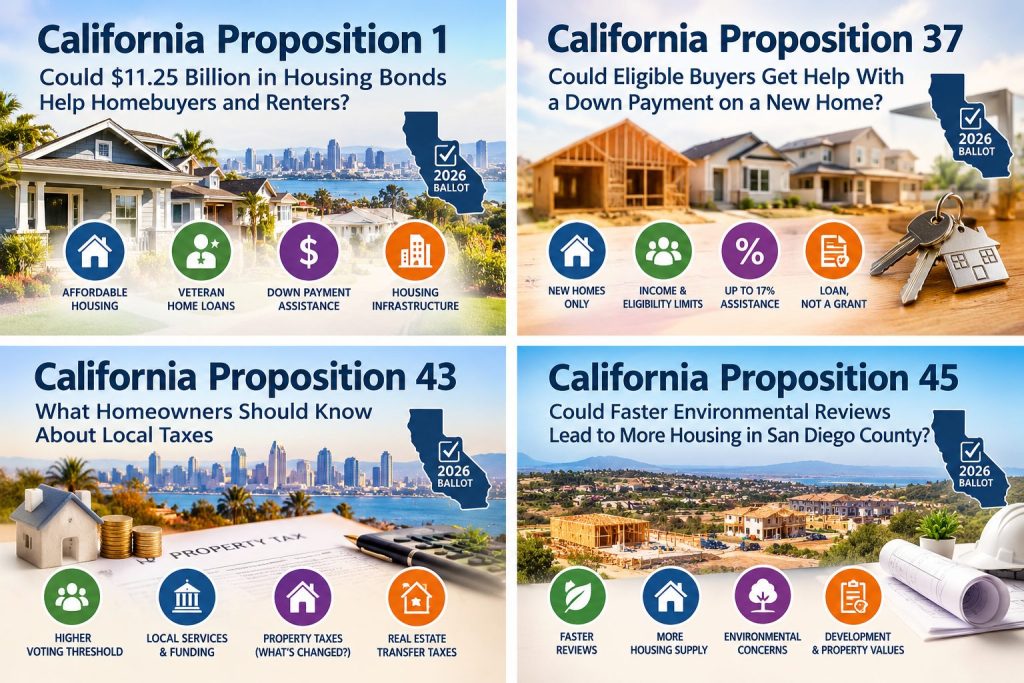
California Proposition 43: Could It Affect Homeowners and Local Communities?
Property ownership involves more than a mortgage payment. Local taxes, infrastructure, public services, and community funding can also influence the cost of living and the attractiveness of a neighborhood.
California Proposition 43, on the November 3, 2026, ballot, would change how certain local tax measures can be approved by voters.
The measure proposes raising the approval threshold for specified voter-proposed local special taxes from a simple majority to two-thirds.
For San Diego County homeowners, this raises several questions:
- Could it reduce the likelihood of new local taxes?
- Would it change existing property tax bills?
- Could it affect funding for fire protection, roads, or affordable housing?
- What would it mean for real estate transfer taxes?
The answers require an important distinction between changing the rules for approving future taxes and changing taxes that already exist.
Sources: California Secretary of State — Proposition 43 and Legislative Analyst’s Office — Proposition 43 Analysis.
What Is Proposition 43?
Proposition 43 is a proposed constitutional amendment placed on the ballot by the California Legislature.
Under the measure, beginning January 1, 2027, new, increased, or extended local special taxes proposed through voter initiatives would require two-thirds approval.
A special tax is a tax dedicated to a specific purpose, rather than a tax whose revenues can be used for general government purposes.
The proposal responds to recent court decisions that have allowed certain special taxes placed on the ballot through voter signature gathering to pass with a simple majority.
Proposition 43 would change the approval threshold for the specified taxes.
Source: Official Proposition 43 Analysis.
How Would the Voting Threshold Change?
Consider a hypothetical local tax measure receiving 100,000 votes.
Under a simple-majority standard, more than 50,000 votes in favor would be sufficient.
Under a two-thirds standard, approximately 66,667 votes in favor would be required.
The difference could determine whether a proposed tax is approved.
This example illustrates the voting thresholds; it does not describe a particular San Diego County ballot measure.
Proposition 43 would not mean that every local tax requires two-thirds approval. Its provisions apply to the specified category of voter-proposed local special taxes.
Would Proposition 43 Lower Property Taxes?
No automatic property tax reduction is specified by the measure.
Proposition 43 changes the voting requirements for certain future local special taxes. It does not establish a general reduction in existing property tax rates or eliminate all local taxes.
The distinction matters because California property owners may pay several types of taxes and assessments, each governed by its own rules.
A homeowner should not assume that approving Proposition 43 would reduce an existing property tax bill.
What About Real Estate Transfer Taxes?
Real estate transfer taxes are particularly relevant to sellers because they can be part of the transaction costs associated with transferring property.
The official voter guide includes arguments both for and against Proposition 43 that refer to local taxes, including real estate-related taxes. However, the measure’s official summary focuses on the approval threshold for specified voter-proposed local special taxes.
It does not establish a blanket statewide elimination of real estate transfer taxes.
Whether a particular transfer tax would be affected requires examining the applicable law, the tax’s purpose, how it was enacted, and whether it falls within the measure’s provisions.
For homeowners considering selling, it would be a mistake to assume that Proposition 43 would automatically eliminate a transfer tax in their city.
Source: Official Proposition 43 Summary and Arguments.
Could It Affect San Diego County Services?
Potentially.
Local governments use tax revenues to support services and infrastructure that can affect residents and neighborhoods.
Depending on future decisions, local special taxes may be proposed to fund services such as:
- Fire protection and emergency response.
- Roads and transportation.
- Schools and other public facilities.
- Hospitals and health services.
- Affordable housing programs.
- Other designated community improvements.
If a proposed tax fails to reach the required threshold, the associated revenue may not be collected.
Supporters of Proposition 43 argue that a higher threshold provides stronger taxpayer protection. Opponents argue that it could make it more difficult for voters to fund important local services.
These are competing policy arguments. The official fiscal analysis does not predict which specific local services would lose funding.
What Does the Official Fiscal Analysis Say?
The Legislative Analyst’s Office identifies the possibility that local governments would collect less tax revenue in the future than they otherwise would.
The actual financial impact is unknown because it depends on future decisions by local governments and voters.
The measure does not specify a particular reduction in San Diego County revenue or identify a guaranteed change to local spending.
Source: Legislative Analyst’s Office — Proposition 43.
Could Proposition 43 Affect Home Values?
Any effect on residential property values would likely be indirect and would depend on how the measure influences future local decisions.
For example, a community might find it more difficult to approve a special tax for a particular infrastructure or public-service project.
On the other hand, preventing a proposed tax from passing could avoid an additional financial obligation for residents.
The real estate consequences would depend on the type of tax, the purpose of the revenue, the affected community, and how buyers and sellers value the associated costs and services.
There is no reliable basis for predicting a specific increase or decrease in San Diego County property values from Proposition 43 alone.
What Should Homeowners and Sellers Watch For?
If Proposition 43 passes, homeowners should monitor future local ballot measures and understand whether the proposed tax is covered by the new voting threshold.
Sellers should continue to review applicable transfer taxes and transaction costs when preparing a property for sale.
Buyers should understand the taxes and assessments associated with a property and avoid assuming that a statewide ballot measure automatically changes their obligations.
Real estate professionals should distinguish between the measure’s actual legal effect and campaign statements describing its intended benefits or potential disadvantages.
Final Thoughts
Proposition 43 would change the approval threshold for certain voter-proposed local special taxes, beginning in 2027.
Supporters view the measure as a way to strengthen taxpayer protections. Opponents argue that it could make it more difficult to fund essential community services.
For San Diego County homeowners, the practical effect would depend on future local tax proposals and how those proposals fare under the new rules.
The most important point is that Proposition 43 is not an automatic property tax cut.
Homeowners should evaluate the measure based on what it would change in the tax approval process and separately review the taxes that apply to their own properties.
Have questions about local taxes, selling costs, or the San Diego County housing market?
Steve Cardinalli can help you understand property-specific considerations and the local market factors that matter when buying or selling a home.
California Proposition 1 — Could $11.25 Billion in Housing Bonds Help Homebuyers and Renters?
California Proposition 37 — Could Eligible Buyers Get Help With a Down Payment on a New Home?
Election information current as of October 10, 2026. This article provides general information and is not legal or tax advice. Consult the official ballot materials and a qualified tax or legal professional for advice about a particular tax or property.
Steve Cardinalli
Real Estate Professional, 01323509
(760) 814-0248
Steve@Cardinalli.com
www.Cardinalli.com
Century 21 Affiliated Fine Homes & Estates
Village Faire in Carlsbad Village
300 Carlsbad Village Dr, 223
Carlsbad, CA 92008


