

 Facebook
 X
X
 Pinterest
 Copy Link
What is Proposition 50?
Proposition 50 asks voters in California whether to adopt a new, legislature-drawn map of the state’s 52 U.S. House congressional districts (starting with the 2026 election) rather than continuing with the independent California Citizens Redistricting Commission’s map.
- A “Yes” vote: use the new maps (drawn by the Legislature) until after the 2030 Census.
- A “No” vote: keep the current Commission-drawn map until the next normal cycle.
The rationale provided by supporters: a response to mid-decade redistricting in states like Texas that they say is skewed to benefit Republicans. California’s leadership says this is a necessary defense of representation.
Opponents argue that this is a partisan power grab that undermines the independence of the Commission and raises questions about fairness.
So bottom line: Prop 50 is not directly a housing-measure (like property-tax relief, land-use policy or affordable-housing bonds) — it’s about political maps for federal representation.
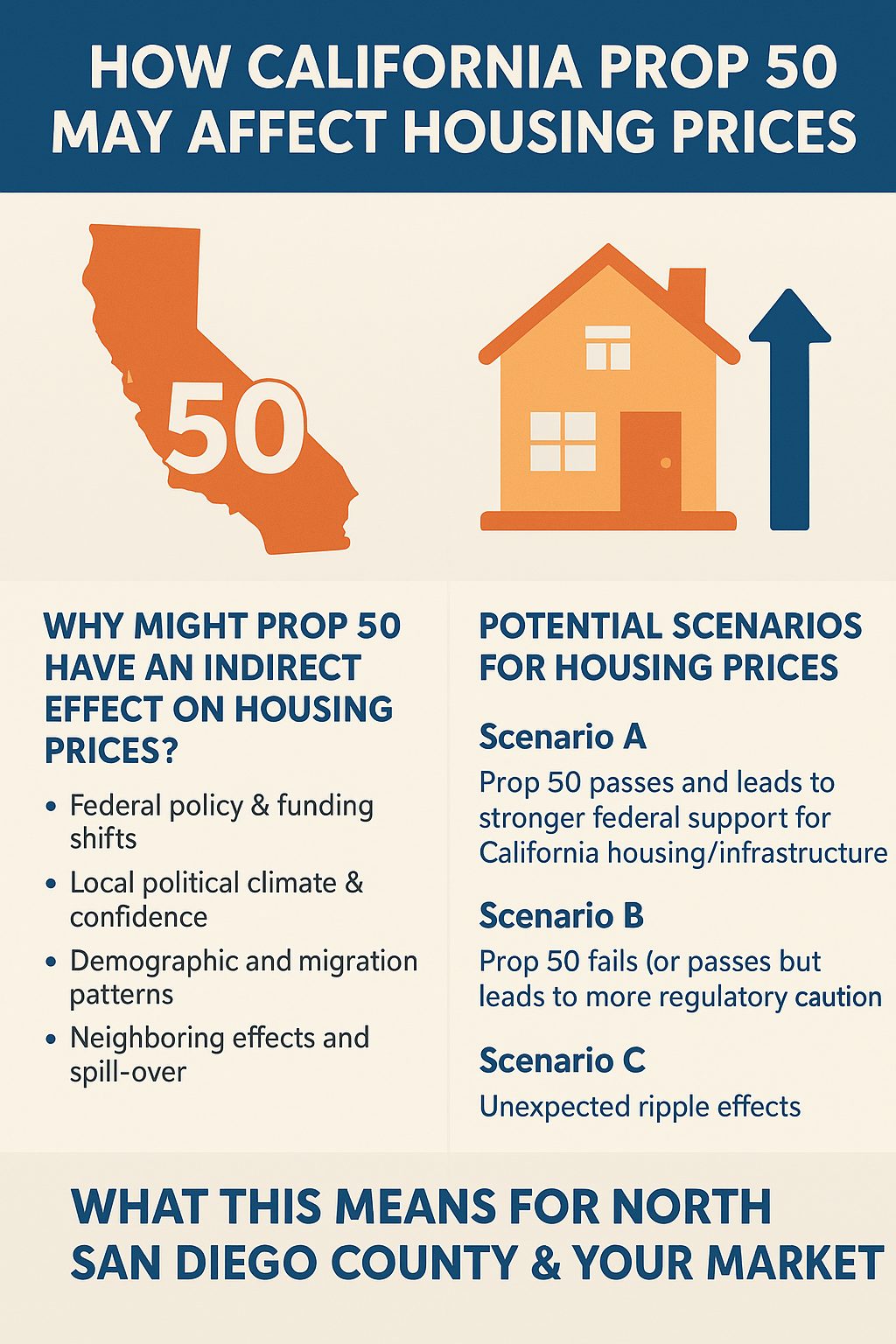
Why might Prop 50 have an indirect effect on housing prices?
Even though Prop 50 doesn’t directly regulate housing or property taxes, changes in political representation and policy can trickle into the housing market. Here are mechanisms to consider:
- Federal policy & funding shifts
- Congressional representation affects how California’s interests are advanced in Washington — e.g., infrastructure funding, disaster relief, affordable housing grants, tax-policy decisions.
- If Prop 50 results in a map that shifts power (for one party or another), that could influence federal spending or regulatory posture affecting housing supply, insurance, and tax incentives which ultimately impact housing demand and supply.
- Local political climate & confidence
- Real-estate markets are sensitive to expectations about growth, migration, tax policy, land-use policy and regulatory risk. If voters believe that political power will shift in ways that favor more development, or conversely more restrictions, that can influence investor sentiment and buyer demand.
- Demographic and migration patterns
- The drawing of congressional districts may highlight or shift emphasis on certain communities (for example, places of high growth, younger population, etc.). Over time this may correlate with trends in housing demand in those areas, especially if representation leads to different prioritisation of infrastructure or services.
- Neighboring effects and spill-over
- While Prop 50 is statewide, some regions of California (including North San Diego County) may feel indirect effects: if statewide policy shifts (taxation, regulation) or if the overall investment climate changes, regional housing prices may respond.
So in short: the effect is indirect and likely modest and gradual. But as a real-estate professional you can position yourself to monitor these links, especially since California’s housing market is sensitive to policy changes.
Potential Scenarios for Housing Prices
Here are a few plausible scenarios — keeping in mind the speculative nature.
Scenario A: Prop 50 passes and leads to stronger federal support for California housing/infrastructure
- If the new maps favour a party aligned with heavier investment or regulatory easing in housing/land-use, one could expect increased supply (e.g., more development approval, greater infrastructure funding) → This could moderate price growth (or slow the appreciation) as supply improves.
- Simultaneously, stronger infrastructure and services could boost demand in particular sub-markets (e.g., near new development corridors) → localized price upticks.
Scenario B: Prop 50 fails (or passes but leads to more regulatory caution)
- If the independent commission stays in place and the political status quo remains, perhaps policy changes are more incremental → housing prices may continue on their current trajectory, largely driven by supply constraints, migration, interest rates.
- If sentiment becomes uncertain (because of partisan instability), then buyers might become more cautious, potentially slowing demand growth.
Scenario C: Unexpected ripple effects
- For example, if the shift in congressional representation results in federal tax-law changes (capital gains, property tax, mortgage interest deduction) or major changes in disaster/insurance funding (wildfire risks, sea-level rise insurance) — these could have material effects in California housing markets (especially high-risk areas).
- Regions like North San Diego County could benefit if, say, new policy spurs more housing development, improved transit, or more favourable insurance/regulation environment.
What this means for North San Diego County & your market
As someone working in real estate in North San Diego County, here are some take-aways:
- Focus on local fundamentals: While Prop 50 is state-wide, your local market will still largely respond to factors like inventory, interest rates, regional job growth, migration from other states, land-use/development constraints.
- Stay alert for policy shifts: If Prop 50 passes and leads to changes in federal funding for housing, infrastructure or disaster mitigation (which is relevant in California), you could anticipate new development or neighbourhood revitalisation in your area — that may drive upside price potential, particularly for early-moving buyers/investors.
- Educate your clients: Many buyers/sellers may not understand the connection between congressional maps and housing markets. You can provide value by explaining that policy and representation can influence the real-estate ecosystem — even if indirectly.
- Watch risk zones: California’s market has unique risk factors (wildfire, sea-level rise, insurance volatility). If policy changes stemming from representation affect how these risks are handled (federal disaster funding, insurance subsidies), that could shift value differentials across micro-markets (e.g., coastal vs inland, fire-prone vs less risky).
- Marketing angle: If you anticipate that certain sub-markets will benefit from infrastructure investment or favourable policy change (post-Prop 50), you might highlight that in your listings/communications (e.g., “Positioned to benefit from upcoming federal infrastructure allocation”).
- Timing matters: Changes in maps won’t immediately change housing supply/demand overnight. But over the next few years (2026-2030) you may see gradual shifts. Positioning early can give you an edge.
What won’t happen (or is unlikely)
- Prop 50 by itself will not directly change local zoning, reduce property taxes, or immediately release large new tracts of housing supply.
- It does not guarantee that housing prices will skyrocket (or crash) — many other forces dominate (interest rates, economy, migration, local land‐use policy).
- Just passing Prop 50 doesn’t guarantee one party sweeping victory; campaigning, candidate quality, and turnout still matter.
- Because the measure is about federal maps, its immediate tangible effect on your local real-estate market may be subtle rather than dramatic.
Key Takeaways for Blog Readers
- Even though Proposition 50 isn’t a housing measure, it matters for housing — because representation and federal policy affect the broader ecosystem.
- For buyers/sellers in North San Diego County: monitor how policy changes stemming from Prop 50 (if passed) could affect infrastructure, disaster funding, regulation, and hence local real-estate dynamics.
- Advise clients that real-estate remains largely about fundamentals — supply/demand, rates, location — but policy overlay is the “hidden lever”.
- Encourage clients to think 3-5 years ahead (to 2026-2030) rather than just immediate gains, since many effects play out over time.
- Use your role as a trusted advisor to highlight how large state and federal political shifts can filter down to local housing markets, helping differentiate you in a competitive market.
Final Thoughts
In sum: Proposition 50 is not a game-changer for housing in the short term, but it may subtly shift the playing field over the medium term. As a real-estate professional you can turn this into an opportunity: by staying ahead of policy shifts, educating clients, and positioning your market accordingly. In California’s complex housing environment — especially in high demand regions like North San Diego County — being attuned to these indirect drivers can set you apart.
Steve Cardinalli
Real Estate Professional, 01323509
(760) 814-0248
Steve@Cardinalli.com
www.Cardinalli.com
Century 21 Affiliated Fine Homes & Estates
Village Faire in Carlsbad Village
300 Carlsbad Village Dr, 223
Carlsbad, CA 92008
Be the first to know about the market trend in your community at Neighborhood News


