

 Facebook
 X
X
 Pinterest
 Copy Link
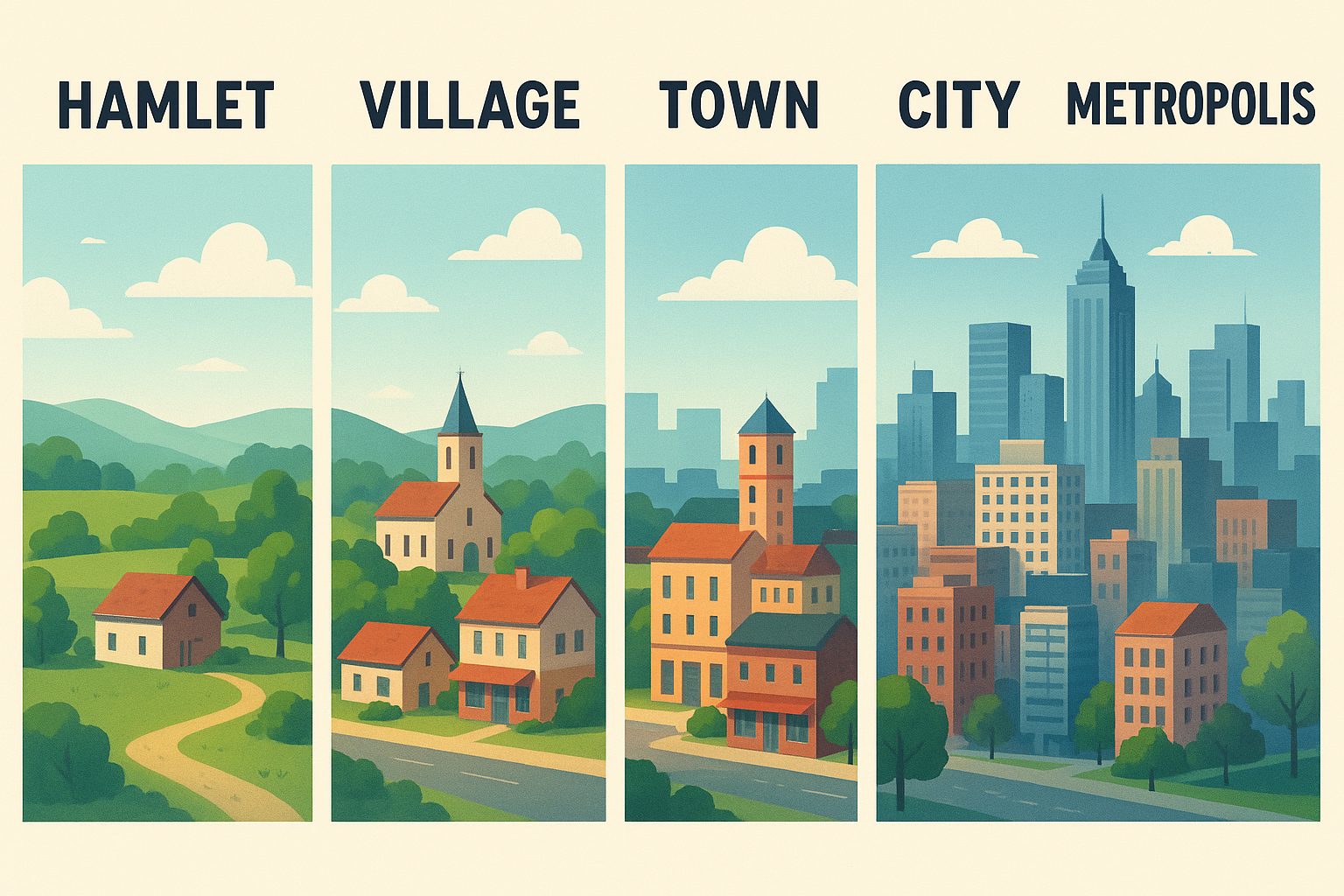
Understanding the Difference Between a Hamlet, Village, Town, City, and Metropolis
When it comes to describing where we live, terms like hamlet, village, town, city, and metropolis often get used interchangeably — but they each have distinct meanings rooted in population size, infrastructure, and governance. Whether you’re exploring rural communities or urban centers, understanding these distinctions helps paint a clearer picture of how human settlements grow and function.
🏡 Hamlet: The Smallest Settlement
A hamlet is the tiniest form of a community — often just a handful of homes, farms, or cottages clustered together.
- Population: Usually fewer than 100 people.
- Features: No formal government, few (if any) businesses, and limited services.
- Example: A small crossroads community with a general store or a church might qualify as a hamlet such as Campo.
Hamlets often rely on nearby villages or towns for schools, shops, and local governance.
🏘️ Village: A Close-Knit Community
A village is the next step up in size and organization.
- Population: Typically a few hundred to a few thousand residents.
- Features: Basic services like a post office, small stores, or a primary school.
- Governance: May have a local council or village board.
- Example: Del Mar.
Villages often serve as the heart of rural life, balancing open space with a sense of community. They’re small enough for everyone to know each other, yet large enough to support a local economy.
🏙️ Town: The Middle Ground
A town bridges the gap between rural simplicity and urban convenience.
- Population: Generally 5,000 to 50,000 people, though this can vary widely by country.
- Features: Schools, supermarkets, healthcare facilities, and organized local government.
- Character: Towns often act as regional hubs for nearby villages and rural areas.
- Example: Encinitas.
Towns offer the conveniences of modern living without the fast pace or density of a large city.
🌆 City: The Urban Core
A city is a densely populated area with a broad range of economic, cultural, and administrative roles.
- Population: Usually over 50,000 residents, though official designations vary.
- Features: Extensive infrastructure, diverse industries, major schools, hospitals, and cultural attractions.
- Governance: Cities have mayors and city councils managing complex systems and budgets.
- Example: Carlsbad, Oceanside and San Marcos.
Cities are the engines of economic growth, attracting people for jobs, education, and entertainment.
🌇 Metropolis: The Major Center
A metropolis is a large and influential city — often the heart of a region or country.
- Population: Typically exceeds a million residents.
- Features: Major transportation networks, global businesses, universities, and cultural institutions.
- Example: San Diego is a classic metropolises.
Metropolises often expand into metropolitan areas, where multiple cities and suburbs blend together, forming sprawling urban regions that influence entire economies.
🧭 From Hamlet to Metropolis — A Journey of Growth
Each stage in this hierarchy represents more than just size; it reflects the evolution of human interaction, economy, and community. Hamlets embody tranquility and simplicity, while metropolises capture the energy and complexity of modern civilization.
No matter where you call home — whether it’s a peaceful hamlet or a bustling metropolis — each type of settlement plays a vital role in the social and economic fabric of our world.
Steve Cardinalli
Real Estate Professional, 01323509
(760) 814-0248
Steve@Cardinalli.com
www.Cardinalli.com
Century 21 Affiliated Fine Homes & Estates
Village Faire in Carlsbad Village
300 Carlsbad Village Dr, 223
Carlsbad, CA 92008
Be the first to know about the market trend in your community at Neighborhood News


