

 Facebook
 X
X
 Pinterest
 Copy Link

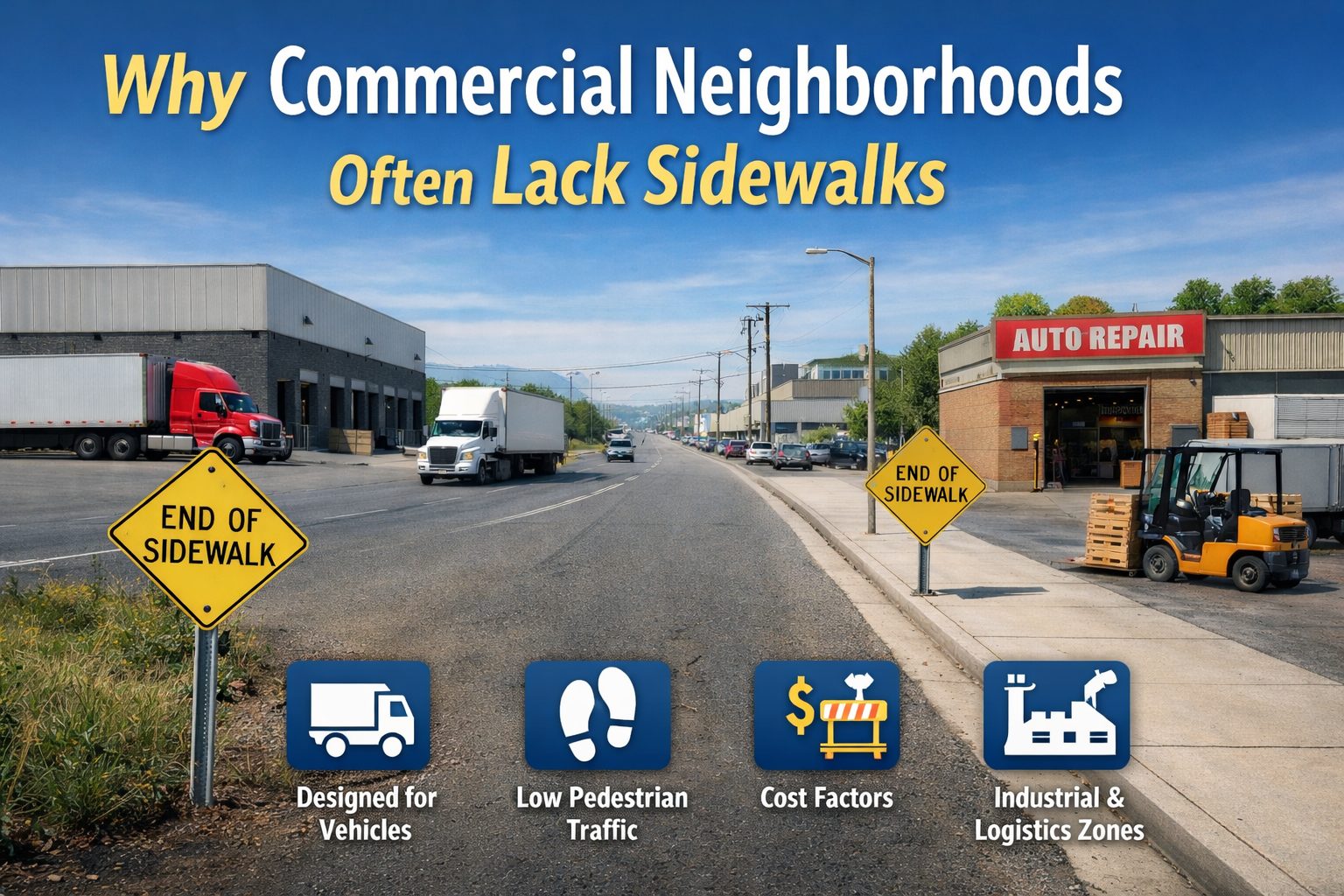
Why Commercial Neighborhoods Often Lack Sidewalks
If you’ve ever driven through an industrial park or commercial corridor and noticed the absence of sidewalks, you’re not imagining it. Unlike residential neighborhoods, many commercial areas are designed with vehicles—not pedestrians—in mind. Here’s why sidewalks are often missing in commercial zones and what it means for property owners, tenants, and investors.
1. Zoning and Land Use Priorities
Commercial and industrial zones are typically planned for businesses that rely on vehicle access, deliveries, and logistics. City zoning codes often prioritize truck circulation, loading zones, and parking over pedestrian infrastructure.
2. Lower Pedestrian Demand
Many commercial properties—such as warehouses, distribution centers, auto repair shops, and manufacturing facilities—do not generate consistent foot traffic. Employees usually arrive by car, and customers may visit infrequently or by appointment, reducing the perceived need for sidewalks.
3. Large Parcel Sizes and Setbacks
Commercial parcels are often larger than residential lots and include wide setbacks, loading areas, and driveways. Installing sidewalks across long frontages can be costly and may conflict with frequent curb cuts for trucks and service vehicles.
4. Cost vs. Benefit Considerations
Sidewalks require construction, maintenance, and ADA compliance. In areas where pedestrian use is minimal, municipalities may determine that the cost outweighs the benefit—especially when public budgets are limited.
5. Safety Concerns
In industrial areas with heavy truck traffic, forklifts, or large delivery vehicles, separating pedestrians from vehicles can actually improve safety. In some cases, limiting pedestrian access reduces liability and accident risk.
6. Historical Development Patterns
Many commercial districts were built decades ago, before walkability became a planning priority. Older industrial parks and business corridors often predate modern urban design standards that now encourage sidewalks and mixed-use development.
7. Private Roads and Easements
Some commercial areas are served by private roads rather than public streets. In these cases, sidewalks are not always required unless triggered by new development or major renovations.
What This Means for Real Estate Value
While a lack of sidewalks can reduce walkability and limit certain uses (like retail or mixed-use redevelopment), it may have little to no negative impact on traditional commercial or industrial property values. In fact, for logistics-heavy users, fewer pedestrian features can be seen as a functional advantage.
However, as cities push toward mixed-use, transit-oriented, and pedestrian-friendly development, commercial neighborhoods with sidewalks may gain long-term flexibility and broader tenant appeal.
Bottom Line
Commercial neighborhoods often lack sidewalks because they were designed for efficiency, vehicles, and business operations—not foot traffic. As planning priorities evolve, sidewalks are becoming more common in newer commercial developments, but their absence in older areas is usually intentional and market-driven rather than an oversight.
 Steve Cardinalli
Real Estate Professional, 01323509
(760) 814-0248
Steve@Cardinalli.com
www.Cardinalli.com
Century 21 Affiliated Fine Homes & Estates
Village Faire in Carlsbad Village
300 Carlsbad Village Dr, 223
Carlsbad, CA 92008
Be the first to know about the market trend in your community at Neighborhood News


