

 Facebook
 X
X
 Pinterest
 Copy Link
The Tax Benefits of Owning a Home in San Diego County
Buying a home in San Diego County doesn’t just provide stability, a place to call your own and the chance to build equity—it also opens up a number of tax benefits you should know about. Of course, every homeowner’s situation is different so you’ll want to consult your tax professional. But here’s a broad, blog-style overview of the key tax advantages (and some of the limitations) of home ownership in California (and thus for San Diego County).
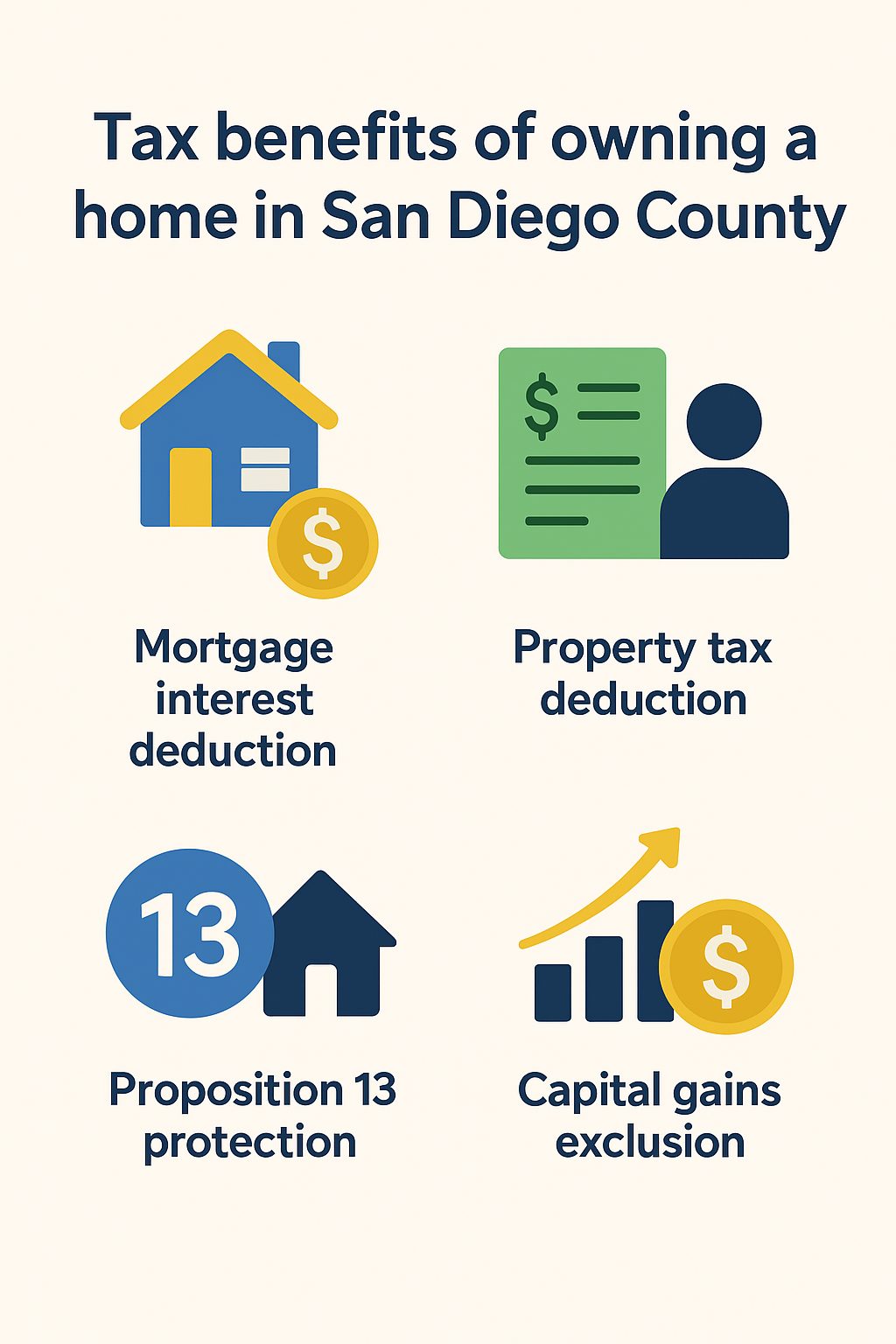
1. Mortgage Interest Deduction
One of the classic tax benefits of home-ownership is the ability to deduct the interest on your mortgage.
- If you itemize your deductions on your federal tax return, you may deduct the interest you pay on a qualified home loan for your primary residence (and in many cases a second home).
- Under current rules: For mortgages taken out after December 15, 2017, the deduction limit is on interest paid on up to $750,000 of mortgage debt for married couples filing jointly (or $375,000 if married filing separately). For mortgages taken out before that date, older rules (e.g., $1 million limit) may apply.
- If you moved money around (for example a home-equity loan or line of credit), note: interest you pay may only be deductible if the borrowed funds were used to “buy, build or substantially improve” the home.
What this means for a San Diego homeowner:
If you buy a home, the interest component of your mortgage in early years is often relatively high (because amortization). Deducting this can reduce your taxable income, lowering your tax bill.
But a caveat:
You must itemize your deductions in order to claim mortgage interest. If your total itemized deductions are less than the standard deduction (see later), then the benefit may be minimal or non‐existent.
2. Property Tax Deduction & SALT Cap
Another major benefit: property taxes you pay are in many cases tax‐deductible. But there are also important limits to understand.
Property Tax Deduction
- Homeowners in California can deduct property taxes (and certain other local taxes) on their federal returns, when they itemize.
- In California, for example, there’s also a “homeowners’ exemption” that lowers the assessed value of your principal residence by $7,000 (which modestly reduces the property tax owed).
SALT (State and Local Tax) Deduction Cap
- Under federal tax law (the Tax Cuts and Jobs Act of 2017 and subsequently), the deduction for state and local taxes (SALT) — which includes property tax, state income tax, and local sales tax — is capped at $10,000 (for married filing jointly) for tax years 2018 through 2025.
- Accordingly: Even if you pay $12,000 (or $15,000) in property taxes in San Diego County, your deduction for federal purposes may be limited by that $10,000 cap (if your state income tax + property tax + sales tax combined exceed it).
What this means for a San Diego homeowner:
Since San Diego is a higher-cost area, property tax bills can be sizeable. The ability to deduct them is real, but the SALT cap often limits how much benefit you get at the federal level. At the state level (California), there is no SALT cap effect, so you may still deduct full property tax on your state tax return (depending on your circumstances) because California does not impose that same $10k cap for its own tax calculus.
3. Capital Gains Exclusion When You Sell
Owning your home gives you a powerful benefit when it’s time to sell: the capital gains tax exclusion.
- Under federal law, if you’ve lived in your home as your primary residence for at least two of the last five years, you can exclude up to $250,000 of capital gain from your income if you are single, or up to $500,000 if married filing jointly.
- This means: Suppose you buy a home in San Diego County, live in it for 2+ of the last 5 years, and sell it for a higher price—if your gain falls under those thresholds, you may owe no federal capital gains tax on that portion.
- In California, your gain may still be subject to the state tax, but the federal exclusion is considerable.
Why this matters in San Diego:
With home prices and appreciation in many San Diego neighborhoods, the potential gain can be large. The exclusion gives you peace of mind that a large portion (or all) of the gain may avoid federal tax—with proper planning.
4. Homeowners’ Exemption & Proposition 13 Protections
In California, there are constitutional and statutory protections that benefit homeowners—not just tax deductions but structural advantages.
- California Proposition 13 (1978) limits the property tax rate on real property to 1% of the assessed value (except for voter-approved local assessments) and restricts annual assessment increases of the taxable value of a property to a maximum of 2% per year, unless there is a change in ownership or new construction.
- The “homeowners’ exemption” in California allows a reduction in assessed value of $7,000 for a qualified residence. (As noted above.)
Why this is beneficial:
Even though California property values (and thus taxes) may be high in San Diego County, these protections illustrate that tax burdens don’t rise uncontrollably. Your tax is limited to 1% of assessed value (plus voter‐approved amounts), and the assessed value only increases modestly each year (so long as you don’t sell or significantly alter the property). That stability is a meaningful advantage of home-ownership in California.
5. Energy-Efficient Improvement Credits & Home Office Deductions
Beyond the big ticket items, there are additional tax wins for homeowners who make certain investments.
- If you install renewable energy systems (solar panels, battery storage) or make qualified energy-efficient home improvements, you may be eligible for federal tax credits (for example, the Residential Clean Energy Credit) or state incentives.
- If you run a business from home (for example you’re self-employed or work remotely and qualify), you may be able to claim a home office deduction (in certain cases) which allocates a portion of mortgage interest, utilities, repairs and depreciation to that business area.
Relevance for San Diego homeowners:
Given California’s push toward renewable energy and San Diego’s generally favorable climate for solar, this is a meaningful added benefit. If you’re doing business from home or using part of the home exclusively and regularly for business, those deductions may apply.
6. Putting It All Together: What A Homeowner in San Diego Should Know
Here are some practical considerations and pitfalls.
✅ Advantages
- You get to deduct mortgage interest (if you itemize) — that can be one of the largest deductions in early years.
- You can deduct property taxes at the federal level (within limits) and fully (typically) at the California state level.
- You benefit from the capital gains exclusion when you sell your primary residence (assuming you meet conditions).
- California’s Proposition 13 and the homeowners’ exemption give structural tax stability and protection.
- Additional credits or deductions for energy improvements or certain home uses may further benefit you.
⚠️ Limitations / Things to Watch
- To get most of these benefits, you must itemize your deductions. If your itemized deductions (mortgage interest + property tax + other deductible expenses) don’t exceed the standard deduction, it may not “pay” for its complexity. For example: Some homeowners discover they still take the standard deduction because it’s larger.
- The SALT deduction cap (state and local taxes limitation) means that in high tax states like California, the benefit of property tax deduction is limited on the federal side: you can deduct only up to $10,000 (for the combined state income + property + sales taxes) for many taxpayers.
- The mortgage interest deduction limit ($750k) means if you purchase a very expensive home with a large loan, a portion of the interest might not be deductible under the newer rules.
- Deductions change year to year—as do tax laws—so staying updated is critical.
💡 Tips for San Diego Homeowners
- Keep accurate records: mortgage interest statements (Form 1098), property tax bills, receipts for any home improvements, and documentation if you use a home office.
- Early in home-ownership, run projections: How much interest will I pay in year 1? How high are my property taxes (San Diego County has higher home values, and thus higher taxes). Will I exceed the standard deduction when adding everything up?
- Consider state vs federal implications: On the California return, you may have different deduction rules than federally.
- When you sell or refinance, consult tax advice: Because of the capital gains exclusion and potential recapture or reassessment triggers in California, planning ahead helps.
- For energy upgrades: If you’re in San Diego and installing e.g. solar panels, you may reduce your utility bills and claim credits — a double win.
Conclusion
Owning a home in San Diego County brings more than just the emotional and lifestyle benefits—it offers tangible tax advantages, including interest deductions, property tax deductions (within limits), capital‐gain exclusions, structural tax protections via Proposition 13, and potential credits/deductions for energy improvements or business use.
That being said: Buying a home primarily for tax savings isn’t usually wise. The tax benefits help, but they typically don’t overwhelm the costs of home-ownership (maintenance, insurance, property tax, mortgage rates, etc.). Instead think of them as one of several factors in the overall decision.
Steve Cardinalli
Real Estate Professional, 01323509
(760) 814-0248
Steve@Cardinalli.com
www.Cardinalli.com
Century 21 Affiliated Fine Homes & Estates
Village Faire in Carlsbad Village
300 Carlsbad Village Dr, 223
Carlsbad, CA 92008
Be the first to know about the market trend in your community at Neighborhood News


