Staging November 25, 2025

The Pros and Cons of Staging a Real Estate Listing — And When Using Your Own Furniture Makes Sense

The Pros and Cons of Staging a Real Estate Listing — And When Using Your Own Furniture Makes Sense

When you’re preparing to list a home, staging is one of the most powerful tools in your marketing toolkit. But it’s not a one-size-fits-all solution. Here’s a balanced look at the advantages and trade-offs — plus a closer look at how using your own furniture (instead of rented staging pieces) can save money.

Why Stage Your Home? The Upside

  1. Make a Strong First Impression
    First impressions matter — especially online. Staged homes create a warm, visually compelling story that helps buyers emotionally “move in.”
  2. Sell Faster
    Staged homes often spend less time on the market. According to stagers, a well-presented property accelerates buyer interest.
  3. Potentially Higher Offers
    Because a staged home feels more “ready to live in,” buyers may perceive it as more valuable — and submit stronger offers.
  4. Better Listing Photos
    Staging makes spaces more photogenic. With well-placed furniture, lighting, and decor, each room looks intentional — helping your online images stand out.
  5. Highlights the Home’s Strengths / Minimizes Weaknesses
    A good stager strategically draws attention to architectural features, flow, and usable space — while downplaying quirks or flaws.
  6. Creates Competitive Edge
    In a crowded market, staging can differentiate your listing. It signals that the property is cared for and professionally marketed, which can attract more serious buyers.
  7. Strong ROI (Return on Investment)
    Many sellers see staging pay off: for every dollar invested, they may recoup multiples through a faster sale, fewer price reductions, or higher offers.

The Trade-Offs: What to Watch Out For

  1. Cost
    Staging isn’t free. If you hire a professional, the costs can add up, especially when factoring in furniture rental or labor.
  2. Time & Logistics
    There’s prep involved: decluttering, rearranging, possibly storing items, and coordinating with stagers. That takes time — and sometimes delays listing.
  3. Risk of Over-Staging
    You can go too far. If staging feels too artificial or over-designed, buyers may be turned off — it can make the space feel less “real.”
  4. Maintenance During Showings
    Once staged, you’ll need to keep things looking pristine — dusting, tidying, and sometimes rearranging back to the staged layout before showings.
  5. Not Always Necessary
    In very hot markets, or for certain property types, staging’s impact may be less pronounced.
  6. Upfront Investment Risk
    If the home doesn’t sell quickly, staging costs can linger (especially if you’re paying for rented furniture, or monthly staging fees).

Using Your Own Furniture: A Smart, Cost-Effective Approach

One of the smartest staging strategies (especially for budget-conscious sellers) is to use your own furniture rather than renting staging pieces. Here’s why that works — and how to do it well.

Benefits:

  • Lower Cost: You avoid rental fees, delivery, and pick-up charges. According to data for San Diego, staging with your own furnishings can cost much less than renting.
  • Authenticity: Your own furniture gives a lived-in, genuine feel — buyers can more easily visualize real life in the space.
  • Control Over Style: You pick pieces that highlight the home’s character. With some guidance from a stager, you can arrange what you have to maximize flow and appeal.
  • No Need for Storage: Since you’re not removing everything, you minimize or eliminate the cost (or hassle) of storing personal items.

Considerations / Tips for Using Your Own Furniture:

  1. Have a Stager Consult or Guide You
    Even if you don’t rent, a stager can help “edit” — tell you what to keep, what to tuck away, how to arrange it to maximize space.
  2. Declutter
    Use the staging process as an opportunity to remove personal items, excess stuff, or furniture that doesn’t serve the space.
  3. Neutralize / Depersonalize
    Try to style rooms in a way that’s appealing to many buyers — minimize overly bold or personal pieces.
  4. Use Accessories Strategically
    Use throws, pillows, rugs, or plants you already own to enhance the look without spending much.
  5. Be Ready for Showings
    Keep some flexibility. You may need to shift things around to suit the best photo angles or flow for walk-throughs.

What Does Staging Cost in San Diego County?

  • Hourly staging services in San Diego run about $150–$170/hour.
  • According to HomeGuide, for a typical listing:
    • Using your own furniture: about $1,000–$3,000 (for staging/design services)
    • For a fully vacant house with rented pieces, prices can go to $3,000–$6,000+.
  • According to Southern California estimates: full staging (with rentals) often ranges $3,000–$10,000, depending on square footage and scope.
  • According to IndustryOversight, staging cost profiles in San Diego show a wide range: between ~$250 and ~$4,400, depending on scope.

Making the Decision: Should You Stage?

Here are some guiding questions to help decide whether staging (and what kind of staging) makes sense for your listing:

  1. What’s the Listing Price & Target Buyer?
    Higher-priced homes may justify a bigger staging spend, because the potential return (faster sale, higher offers) is more significant. For entry-level homes, using your own furniture may be the smarter move.
  2. How Long Do You Expect It to Be on Market?
    If you want a quick sale, investing in staging can pay off. But if you’re testing the market, smaller staging investments or DIY staging might suffice.
  3. What’s Your Current Furniture Situation?
    Do you already have clean, neutral, well-placed furniture? Or would renting be necessary to make the space shine?
  4. Storage / Logistics
    Do you have somewhere to store things you remove? What’s the cost? How will staging coordinate with your moving timeline?
  5. Budget
    What staging budget are you comfortable with — both in terms of dollars and potential risk if the home doesn’t move immediately?

Final Thoughts

Staging is more than just decoration — it’s a strategic marketing move. When done well, it can help your property sell faster, stand out in a crowded market, and potentially command a better price. But it’s not free, and over-investing can cut into your bottom line.

Using your own furniture is a smart, cost-effective path: you get many of the benefits of staging without some of the biggest costs. By combining that with a stager’s savvy eye, you can create a polished, welcoming look that highlights your home’s strengths — all while keeping your budget in check.

When working with sellers in North San Diego County, staging (even partial) can be a competitive advantage in today’s market. But it’s not a guaranteed slam-dunk, so weigh the costs, timeline, and purpose of your listing carefully.


Steve Cardinalli
Real Estate Professional, 01323509
(760) 814-0248
Steve@Cardinalli.com
www.Cardinalli.com
Century 21 Affiliated Fine Homes & Estates
Village Faire in Carlsbad Village
300 Carlsbad Village Dr, 223
Carlsbad, CA 92008


Be the first to know about the market trend in your community at Neighborhood News


Inheritance November 24, 2025

How to Use an Inheritance to Buy a House

How to Use an Inheritance to Buy a House

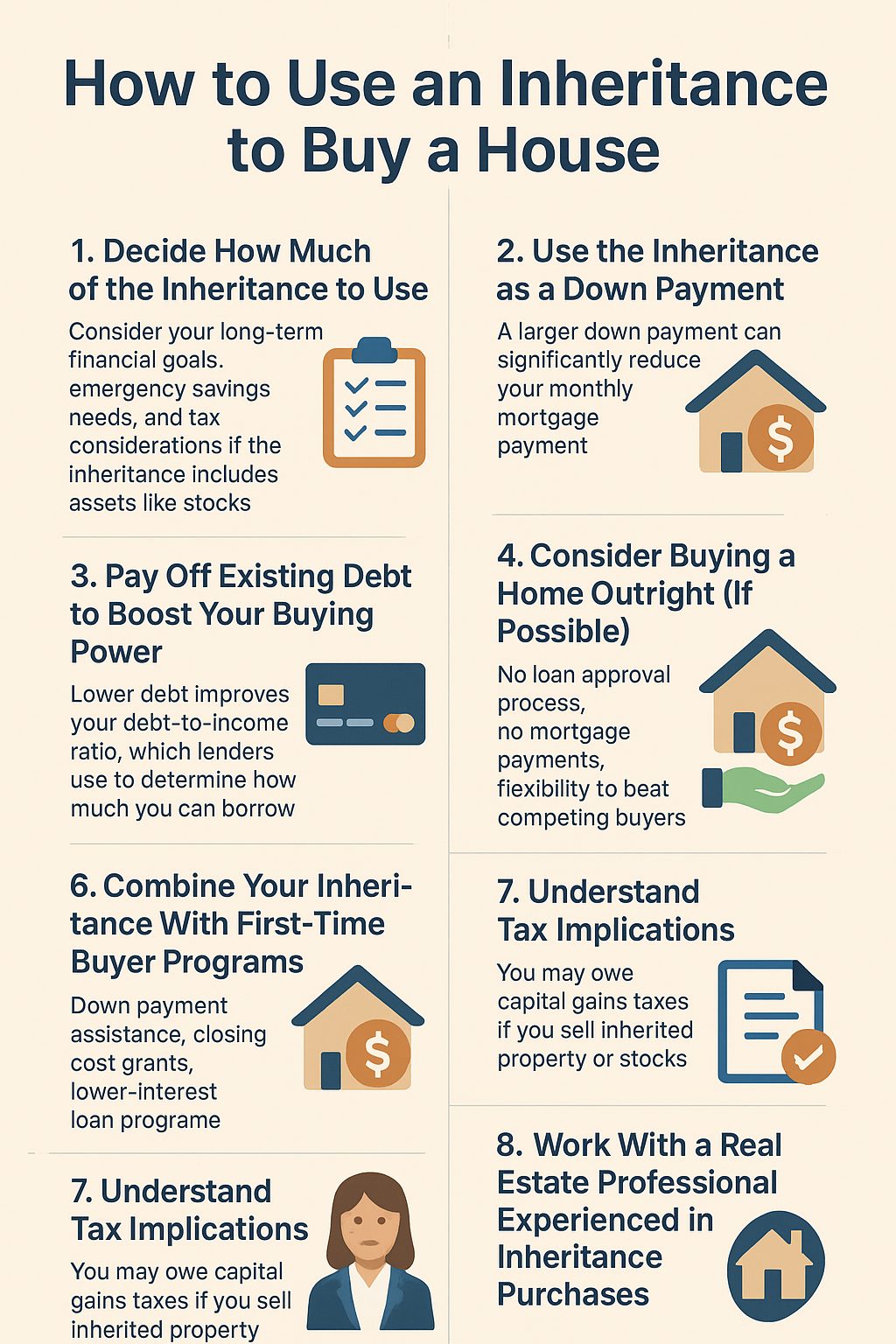
Receiving an inheritance can be a life-changing event. Whether it comes in the form of cash, investments, or property, many people wonder if—and how—they can use that inheritance to purchase a home. In San Diego County’s competitive real estate market, an inheritance can open doors that might otherwise feel out of reach. Here’s what you need to know to make the most of it.


1. Decide How Much of the Inheritance to Use

Before diving into home shopping, determine what portion of your inheritance you’re comfortable using. Consider:

  • Your long-term financial goals
  • Your emergency savings needs
  • Tax considerations if the inheritance includes assets like stocks

Talking with a financial planner can help you balance homeownership goals with preserving long-term wealth.


2. Use the Inheritance as a Down Payment

One of the most common ways to leverage an inheritance is to use it for the down payment:

  • A larger down payment can significantly reduce your monthly mortgage payment.
  • Putting 20% down can help you avoid mortgage insurance, lowering your costs even more.
  • Buyers who can offer a higher down payment often appear stronger and more competitive, especially in San Diego’s multiple-offer environment.

3. Pay Off Existing Debt to Boost Your Buying Power

If a portion of your inheritance is used to pay off high-interest debt—credit cards, student loans, or car loans—you may qualify for a better mortgage rate. Lower debt improves your debt-to-income ratio, which lenders use to determine how much you can borrow.

Sometimes using $10,000–$20,000 to eliminate debt can increase your home-buying budget more than applying that same amount directly toward a down payment.


4. Consider Buying a Home Outright (If Possible)

If your inheritance is large enough, purchasing a home with all cash brings major benefits:

  • No loan approval process
  • No mortgage payments
  • Flexibility to beat competing buyers
  • Lower closing costs

In San Diego County—where cash buyers consistently outperform financed offers—this can be a huge advantage.


5. Use an Inheritance to Buy an Investment Property

Your inheritance doesn’t have to go toward your primary residence. Some buyers use their funds to purchase:

  • A rental property for additional income
  • A fix-and-flip for faster returns
  • A vacation rental in beach neighborhoods like Oceanside, Carlsbad, or Mission Beach

This strategy allows you to build long-term wealth while still preserving part of your inheritance.


6. Combine Your Inheritance With First-Time Buyer Programs

If you’re a first-time buyer in San Diego County, you may still qualify for:

  • Down payment assistance
  • Closing cost grants
  • Lower-interest loan programs

Using an inheritance in combination with these programs can help you stretch your buying power further than using either one alone.


7. Understand Tax Implications

Generally, inheritances are not taxable as income. However:

  • You may owe capital gains taxes if you sell inherited property or stocks
  • Large cash transfers may require proper documentation
  • Lenders may require a paper trail confirming the source of funds

A tax professional can help you structure everything properly before applying for a mortgage.


8. Work With a Real Estate Professional Experienced in Inheritance Purchases

Using inherited funds can involve unique steps—especially when dealing with probate, large transfers, or inherited real estate. Working with a knowledgeable agent ensures:

  • Funds are documented correctly for the lender
  • You make financially strategic decisions
  • You choose neighborhoods and price ranges that align with long-term goals

Final Thoughts

An inheritance can be a powerful tool for achieving homeownership, building equity, and securing long-term financial stability. Whether you’re using it for a down payment, eliminating debt to qualify for more, or investing in real estate, the key is planning wisely and partnering with the right professionals.


Steve Cardinalli
Real Estate Professional, 01323509
(760) 814-0248
Steve@Cardinalli.com
www.Cardinalli.com
Century 21 Affiliated Fine Homes & Estates
Village Faire in Carlsbad Village
300 Carlsbad Village Dr, 223
Carlsbad, CA 92008


Be the first to know about the market trend in your community at Neighborhood News

55+American's with Disabilities Act (ADA)CommunityManufactured HomeMobile HomeModular Home November 22, 2025

My Parents Moved Out of Their 55+ Mobile Home Community — Now What Do I Do?

My Parents Moved Out of Their 55+ Mobile Home Community — Now What Do I Do?

When parents transition out of their long-time home—especially a mobile home in a 55+ community—it can feel overwhelming. Whether they moved for health reasons, downsizing, or to be closer to family, you’re now left handling a property you may not have planned for. The good news? You have several options, and with the right strategy, you can protect your parents’ equity, minimize costs, and make smart real estate decisions.

Here’s a clear guide on what to do next.


1. Confirm Ownership and Park Requirements

Start by reviewing the basics:

Who owns what?

  • Did your parents own the mobile home?
    Many 55+ communities are land-lease parks, meaning you own the home but pay monthly space rent.
  • Or did they own both the home and the land?
    This is more valuable and gives you far more options.

Check park rules

Each community has policies on:

  • Resale requirements
  • Age restrictions
  • Income or credit qualifications for new buyers
  • Pet and parking rules that may affect marketability

Understanding these early helps avoid surprises and streamline your next steps.


2. Determine the Home’s Condition and Market Value

Mobile homes—especially older ones—vary widely in resale value. Consider:

  • Age of the home
  • Condition (roof, HVAC, flooring, appliances, foundation piers/skirting)
  • Park desirability
  • Comparable recent sales in the same community
  • Whether it needs repairs to pass park approval

A local agent familiar with manufactured home communities in San Diego County can help run an accurate value analysis and guide you on updates worth doing (and those you should skip).


3. Decide If You Want to Sell, Rent, or Keep It

You generally have three main paths:

Option 1: Sell the mobile home

This is the most common choice. Selling can:

  • Eliminate ongoing space rent
  • Provide funds to help with your parents’ care or housing
  • Reduce your workload

In land-lease parks, homes often need a buyer approved by the park before closing—an important step to prepare for.

Option 2: Rent it out

Some parks allow rentals, but many senior parks do not.
If rentals are allowed:

  • You may need to manage or hire management
  • You’ll still pay space rent
  • You’ll be responsible for park rule compliance

Always check the park’s CC&Rs before moving forward.

Option 3: Keep it temporarily

If you need time to navigate finances, medical planning, or family decisions, you can:

  • Cover space rent month-to-month
  • Secure the property
  • Prepare it for a later sale

Just be aware that space rent in San Diego County can run between $700–$1,500+ per month, so this option can get costly.


4. Prepare the Home for the Best Outcome

Whether selling or renting, take these steps:

  • Remove personal belongings
  • Clean and declutter
  • Complete basic repairs
  • Get an inspection (optional but helpful for older homes)
  • Improve curb appeal

A well-presented mobile home sells faster and for more money—especially in senior communities where buyers appreciate move-in readiness.


5. Get Support From Professionals Who Understand Senior Housing

A seasoned real estate agent experienced with both 55+ parks and manufactured homes is invaluable. They can help you:

  • Understand park approval processes
  • Price the home correctly
  • Coordinate repairs or cleaning
  • Market to the right buyer pool
  • Navigate emotional family dynamics
  • Ensure all documents and disclosures are handled correctly

If your parents moved into assisted living, an agent can also connect you with resources for downsizing managers, estate liquidators, and senior care advisors.


6. Take Care of the Emotional Side Too

This transition isn’t just logistical—it’s emotional.
Your parents may be sad to leave a familiar community, and you may be feeling the weight of responsibility.

Give everyone a little grace, including yourself. You’re not just handling a property—you’re supporting your family through a major life change.


Final Thoughts

When parents move out of their 55+ mobile home community, the next steps may seem complicated, but you’re not alone. With the right information and a trusted real estate professional on your side, you can make confident decisions that protect your family’s finances and dignity.

If you’d like help evaluating the home or understanding your options in San Diego County, I’m here to guide you through every step.


Steve Cardinalli
Real Estate Professional, 01323509
(760) 814-0248
Steve@Cardinalli.com
www.Cardinalli.com
Century 21 Affiliated Fine Homes & Estates
Village Faire in Carlsbad Village
300 Carlsbad Village Dr, 223
Carlsbad, CA 92008


Be the first to know about the market trend in your community at Neighborhood News

Due DiligenceDue Diligence Fees November 20, 2025

Due Diligence Fees in California Real Estate: What Buyers and Sellers Need to Know

Due Diligence Fees in California Real Estate: What Buyers and Sellers Need to Know

When purchasing a home in California, buyers encounter a variety of terms, timelines, and costs—many of which can feel overwhelming. One that often causes confusion is the “due diligence fee.” While common in other states, especially in the Southeast, due diligence fees are not formally defined in California contracts. However, the concept of due-diligence-related costs absolutely exists here.

Let’s break down what “due diligence fees” mean in California real estate and how they affect both buyers and sellers.


What Is a Due Diligence Fee?

In some states, a due diligence fee is a non-refundable payment from the buyer to the seller, made upfront, giving the buyer the right to investigate the property before moving forward with the purchase.

California does not use this exact system.

However, California’s standard contracts include earnest money deposits and contingency periods, which together function similarly to due diligence fees—just structured differently.


California’s Version of a “Due Diligence Fee”

Instead of paying a non-refundable fee directly to the seller, California buyers typically pay:

1. Earnest Money Deposit (EMD)

This is the buyer’s good-faith deposit, usually 1–3% of the purchase price, held in escrow—not given to the seller.
It becomes refundable or nonrefundable based on the buyer’s contingencies.

2. Inspection and Due Diligence Costs

While not paid to the seller, these costs are part of the buyer’s “due diligence” process and include:

  • Home inspections
  • Termite/pest inspections
  • Roof inspections
  • Sewer line or septic inspections
  • Hazard reports
  • Appraisals
  • Specialized contractor evaluations

These fees are paid out of the buyer’s pocket during the contingency period. They are generally non-refundable, even if the buyer cancels.


Contingency Periods: The Core of Due Diligence in California

California buyers rely on contingencies rather than due diligence fees.

The major contingencies include:

  • Inspection contingency (typically 7–17 days)
  • Appraisal contingency
  • Loan contingency
  • Disclosure review period

During these windows, buyers can investigate the home thoroughly.
If the buyer cancels during an active contingency, the earnest money deposit is protected.

Once the buyer removes contingencies, the EMD becomes at risk—this is the closest parallel to the “nonrefundable due diligence fee” in other states.


Are Sellers Allowed to Ask for a Due Diligence Fee in California?

Yes—but it’s extremely uncommon and must be mutually agreed upon.

A seller could theoretically request:

  • A nonrefundable deposit,
  • A buyer-paid option fee, or
  • A pre-negotiated credit to the seller for taking the property off the market.

However, because California’s contracts are contingency-based, buyer agents typically advise against making nonrefundable payments unless the buyer has a strong reason—such as winning a highly competitive multiple-offer situation.


How Buyers Benefit from California’s System

California’s contingency approach protects buyers by:

  • Allowing withdrawal from the deal if issues arise
  • Protecting the earnest money until contingencies are removed
  • Providing time for inspections, appraisals, and document review
  • Avoiding nonrefundable upfront fees

Buyers can investigate without fear of immediately losing money to the seller.


How Sellers Benefit

Sellers can still protect themselves by:

  • Limiting contingency periods
  • Requesting strong EMD amounts
  • Asking for proof of funds
  • Reviewing preapproval letters
  • Encouraging buyers to shorten contingency timelines in competitive markets

A seller can even request a nonrefundable deposit, though it must be disclosed, negotiated, and agreed to in writing.


Final Thoughts

While California does not formally use “due diligence fees” the way other states do, the combination of earnest money deposits, contingency periods, and buyer-paid inspections functions as California’s equivalent.

For buyers, this system provides protection and flexibility.
For sellers, it offers structure and seriousness from the buyer—especially once contingencies are removed.

Understanding this structure is essential for navigating California’s unique real estate landscape smoothly and confidently.


Steve Cardinalli
Real Estate Professional, 01323509
(760) 814-0248
Steve@Cardinalli.com
www.Cardinalli.com
Century 21 Affiliated Fine Homes & Estates
Village Faire in Carlsbad Village
300 Carlsbad Village Dr, 223
Carlsbad, CA 92008


Be the first to know about the market trend in your community at Neighborhood News

Conviction November 19, 2025

Can a Convicted Person in California Buy Real Estate?

Can a Convicted Person in California Buy Real Estate?

When it comes to real estate, one of the most common questions asked by those with a criminal record is: “Can I still buy a home in California?” The answer is yes — in most cases, a convicted person can buy real estate in California. However, there are a few important factors and exceptions to understand.


The Right to Own Property Still Exists

In California, having a criminal record does not automatically strip someone of their right to buy, own, or sell property. Real estate ownership is considered a civil right, and while some civil rights (like voting or holding public office) may be temporarily affected by certain convictions, property ownership typically is not.

Anyone — including those on probation, parole, or with prior felony convictions — can legally purchase real estate as long as they can meet the financial and contractual obligations involved in the transaction.


💰 Financing Can Be the Biggest Hurdle

The biggest challenge for someone with a criminal record isn’t buying the property itself — it’s qualifying for financing.

  • Conventional Loans: Most lenders will look at credit history, income, and debt-to-income ratio. A criminal conviction usually doesn’t appear in these evaluations unless it affects employment or creditworthiness.
  • FHA, VA, or USDA Loans: Government-backed loans may have additional requirements. Certain serious felonies (such as those involving fraud or financial crimes) can disqualify applicants for a set period.
  • Private Financing or Cash Purchases: If someone pays cash or uses private funding, criminal background checks are rarely relevant. In those cases, the purchase is generally straightforward.

🏠 Buying While on Probation or Parole

It’s still possible to purchase property while under supervision. However, the person may need approval from their probation or parole officer — especially if moving residences or changing counties. The purchase itself is legal, but living arrangements may need official clearance.


⚖️ Restrictions That May Apply

There are a few situations where property ownership could be restricted:

  • Restitution or Fines: If a court-ordered restitution is unpaid, a lien could be placed on property, affecting the sale or transfer.
  • Forfeiture Laws: Property purchased with proceeds from criminal activity can be seized under federal or state forfeiture laws.
  • Certain Federal Convictions: Individuals convicted of specific federal crimes (like money laundering or drug trafficking) may face restrictions if the purchase involves federally insured funds.

🧭 Why Homeownership Still Matters

For many people with past convictions, buying a home is a key step toward rebuilding stability and independence. Homeownership can provide a sense of accomplishment, community, and financial security — and California law does not stand in the way of that goal.


🏡 Final Thoughts

If you or someone you know has a criminal record and wants to buy property in California, the good news is — it’s entirely possible. The key is to ensure all financial obligations are in order, understand any probation or parole restrictions, and work with a real estate agent and lender who can guide you through the process without bias.

Homeownership can be a powerful part of a fresh start, and in California, your past doesn’t have to define your future.


Steve Cardinalli
Real Estate Professional, 01323509
(760) 814-0248
Steve@Cardinalli.com
www.Cardinalli.com
Century 21 Affiliated Fine Homes & Estates
Village Faire in Carlsbad Village
300 Carlsbad Village Dr, 223
Carlsbad, CA 92008


Be the first to know about the market trend in your community at Neighborhood News

Appliances November 17, 2025

What Really Drives Home Value With Appliances

✅ What really drives home value with appliances

Rather than brand name alone, value is driven by:

  • Timely replacement of old or failing appliances so the kitchen looks modern and “move-in ready.” According to KitchenAid (via their homeowner advice) updating appliances (along with floors or counters) can raise value by ~3-7%.
  • Good functionality + energy efficiency: buyers like that they don’t immediately have to budget for replacements and that utilities are lower.
  • Match the neighborhood and price point. If you’re in a luxury area, high-end appliances can tip the scale. But in a mid/entry-market house, an ultra-luxury brand may not recoup the cost.
  • Cohesive look and perceived quality: Stainless (or modern finish) appliances that “look current” help more than the brand name alone.

🔍 What brands tend to help (and why)

Here are some brand cues you can use when advising clients or buying for a property.

  • Luxury/premium brands: For higher-end listings (luxury homes, remodels targeting affluent buyers), brands like Sub‑Zero, Wolf, and Cove are cited as giving the biggest boost to resale value. One review says: “The biggest boost to resale value out of any other luxury appliance brand” for that family of brands.
  • Good mainstream brands: For most homes (mid-market), respected brands like Bosch, LG, GE appear in “best for resale” brand lists.
  • Brand matters less than condition/appearance: On forums (e.g., real estate discussion boards) a common sentiment is that functioning and clean/new looking appliances are more important than brand — e.g.:

    “New appliances don’t add value but rather help in not subtracting value.”


🎯 My recommendation (for your market)

Since you’re in North San Diego County, here’s how I’d advise:

  • If you’re prepping a mid-priced home (say <$1.2 M) for sale: Focus on replacing outdated appliances with modern, reliable models from a good mainstream brand (Bosch, GE Profile, LG). Don’t overspend on ultra-luxury brands unless it fits the home’s price tier.
  • If dealing with a higher-end home (luxury listing): Upgrading to a premium appliance suite (Sub-Zero/Wolf or similar) can help with differentiation and appeal to upscale buyers — but make sure the rest of the kitchen/flooring/finishes supports that level.
  • Make sure the finishes match (stainless or matte black), the appliances are clean and in good repair, and they fit with what buyers expect in your neighborhood. That often moves the needle more than the brand name alone.

In short: I wouldn’t say there’s one brand that always adds the most value — but if I had to pick one marketing-friendly answer, in the luxury tier it would be Sub-Zero/Wolf for highest impact. For the broader mass market, go with a reliable, well-recognized brand (Bosch, LG, GE) and good condition.


Steve Cardinalli
Real Estate Professional, 01323509
(760) 814-0248
Steve@Cardinalli.com
www.Cardinalli.com
Century 21 Affiliated Fine Homes & Estates
Village Faire in Carlsbad Village
300 Carlsbad Village Dr, 223
Carlsbad, CA 92008


Be the first to know about the market trend in your community at Neighborhood News

MechanicalWater Heater November 14, 2025

California Water Heater Requirements: What Every Homeowner Should Know

California Water Heater Requirements: What Every Homeowner Should Know

If you’re buying, selling, or renovating a home in California, one small but critical detail you can’t overlook is your water heater setup. It might not be the flashiest home feature, but an improperly installed or outdated water heater can lead to safety issues, inspection delays, and costly repairs. Here’s what every California homeowner should know about water heater requirements.


1. Earthquake Safety: The Seismic Strapping Rule

California is earthquake country, which means water heaters must be securely strapped to prevent tipping over during a quake.
According to the California Plumbing Code, all water heaters—gas or electric—must be strapped at two points:

  • One strap should be placed in the upper third of the tank.
  • The second should be in the lower third, at least 4 inches above the controls.

Straps must be metal, not just tape or plastic, and should be anchored to wall studs using heavy-gauge screws. Home inspectors always check for this—missing or loose straps can be a red flag in a real estate transaction.


2. Proper Venting and Clearance

For gas water heaters, proper venting is crucial to avoid dangerous carbon monoxide buildup.
Here’s what’s required:

  • A metal vent pipe that leads gases safely outside.
  • Adequate clearance around the unit for air circulation.
  • No storage of flammable materials near the heater.

If you’re replacing a gas model, have a licensed plumber ensure the vent system meets the latest code requirements.


3. Temperature and Pressure Relief (TPR) Valve

Every water heater in California must have a TPR valve—a safety feature that releases pressure if the tank overheats.
The discharge pipe:

  • Must point downward within 6 inches of the floor.
  • Cannot be threaded or capped at the end (so it can safely release pressure).
  • Must be made from approved materials such as copper, CPVC, or galvanized steel.

4. Expansion Tank Requirements

If your home has a closed plumbing system (common in modern homes with backflow prevention devices), you’ll likely need a thermal expansion tank.
This small tank absorbs pressure caused by heated water expanding in the system, preventing leaks and prolonging your heater’s lifespan. Most California building departments now require these for new installations or replacements.


5. Efficiency and Environmental Standards

California leads the way in energy efficiency. New water heaters must meet federal Energy Star efficiency standards and low NOx (nitrogen oxide) emission requirements to reduce air pollution.
Tankless water heaters are becoming increasingly popular across North San Diego County for their energy savings and endless hot water supply.


6. Garage Installations: Elevation and Protection

If your water heater is installed in the garage, state code requires:

  • The unit to be raised at least 18 inches off the floor to prevent ignition of flammable vapors.
  • Installation of a bollard or protective barrier if there’s a chance a car could strike it.

7. Permits and Inspections

Whenever you replace a water heater in California, you’ll need a building permit and final inspection by your local city or county. This ensures the installation meets all safety and energy codes—something that’s especially important if you’re preparing to sell your home.


Bottom Line

Water heater compliance might seem like a small detail, but it plays a big role in safety, efficiency, and resale value. Whether you’re upgrading your system or getting your home ready for the market, ensuring your water heater meets California requirements can help you avoid costly surprises and make your property more appealing to buyers.


Thinking of selling your home in North San Diego County?
Before listing, let’s make sure your property—including your water heater—is in top shape for inspection and ready to impress.

📞 Contact Steve Cardinalli, your local real estate expert, for a pre-listing consultation today.


Steve Cardinalli
Real Estate Professional, 01323509
(760) 814-0248
Steve@Cardinalli.com
www.Cardinalli.com
Century 21 Affiliated Fine Homes & Estates
Village Faire in Carlsbad Village
300 Carlsbad Village Dr, 223
Carlsbad, CA 92008


Be the first to know about the market trend in your community at Neighborhood News

VA November 11, 2025

Understanding VA Loans: Requirements, Advantages, and Disadvantages

Understanding VA Loans: Requirements, Advantages, and Disadvantages

If you’re a veteran, active-duty service member, or eligible surviving spouse looking to buy a home, a VA loan can be one of the best financing options available. Backed by the U.S. Department of Veterans Affairs, this program helps eligible borrowers purchase, build, or refinance homes with favorable terms and little to no money down. However, like any loan program, VA loans come with both advantages and limitations. Here’s a breakdown of what you need to know before applying.


VA Loan Requirements

To qualify for a VA loan, you’ll need to meet several key requirements:

1. Eligibility Criteria

You may be eligible if you meet one of the following:

  • Veterans: Served at least 90 days of active duty during wartime or 181 days during peacetime.
  • Active-Duty Members: Have served at least 90 continuous days.
  • National Guard or Reserves: Served at least six years, or 90 days of active service under Title 10 or Title 32 orders.
  • Surviving Spouses: Unremarried spouses of veterans who died in service or from service-connected disabilities may qualify.

You’ll need a Certificate of Eligibility (COE) to confirm your status, which can be obtained through the VA or your lender.

2. Credit and Income Standards

While the VA doesn’t set a minimum credit score, most lenders require at least 620 or higher. You must also have a stable income and a reasonable debt-to-income ratio (DTI)—generally no more than 41%.

3. Property Requirements

The property must be your primary residence and must meet the VA’s Minimum Property Requirements (MPRs), ensuring it’s safe, structurally sound, and sanitary. Vacation homes and investment properties do not qualify.

4. Funding Fee

Most VA loans require a VA funding fee, a one-time charge (ranging from 1.25% to 3.3% of the loan amount) that helps keep the program running. This fee can be waived for veterans with service-connected disabilities.


Advantages of a VA Loan

VA loans offer several powerful benefits that make them an attractive option:

No Down Payment

Qualified buyers can finance up to 100% of the home’s value—no down payment required. This makes homeownership more accessible, especially for first-time buyers.

No Private Mortgage Insurance (PMI)

Unlike conventional loans with less than 20% down, VA loans don’t require PMI, which can save borrowers hundreds of dollars each month.

Competitive Interest Rates

Because VA loans are backed by the government, lenders typically offer lower interest rates than conventional financing.

Flexible Credit Guidelines

VA loans are often more forgiving of past financial issues, such as bankruptcy or foreclosure, as long as the borrower has reestablished good credit.

Assumable Loans

If you sell your home, the buyer (if eligible) can assume your VA loan, potentially taking advantage of your lower interest rate.


Disadvantages of a VA Loan

While the advantages are significant, there are a few potential drawbacks to consider:

⚠️ Funding Fee

Even though it can be rolled into the loan, the funding fee adds to your overall cost. For example, on a $500,000 loan, a 2.3% funding fee adds $11,500.

⚠️ Primary Residence Only

VA loans can only be used for owner-occupied homes, not for investment properties or vacation homes.

⚠️ Strict Appraisal Standards

The VA appraisal process can be tougher than conventional loans, sometimes making it harder to close on fixer-uppers or older homes that need work.

⚠️ Seller Misconceptions

Some sellers (and even agents) mistakenly believe VA loans are harder to close or involve extra red tape, which can put VA buyers at a disadvantage in competitive markets.


Final Thoughts

A VA loan is one of the most powerful tools available to those who’ve served our country. With no down payment, no PMI, and competitive rates, it can make homeownership much more affordable. However, buyers should also consider the funding fee, occupancy requirements, and appraisal challenges before committing.

If you’re a veteran or service member in North San Diego County, reach out to a VA-approved lender or a local real estate professional familiar with VA transactions. The right guidance can help you take full advantage of this well-earned benefit and find the home you deserve.


Steve Cardinalli
Real Estate Professional, 01323509
(760) 814-0248
Steve@Cardinalli.com
www.Cardinalli.com
Century 21 Affiliated Fine Homes & Estates
Village Faire in Carlsbad Village
300 Carlsbad Village Dr, 223
Carlsbad, CA 92008


Be the first to know about the market trend in your community at Neighborhood News

CitiesCityHamletMetropolisVillage November 9, 2025

Understanding the Difference Between a Hamlet, Village, Town, City, and Metropolis

Understanding the Difference Between a Hamlet, Village, Town, City, and Metropolis

When it comes to describing where we live, terms like hamlet, village, town, city, and metropolis often get used interchangeably — but they each have distinct meanings rooted in population size, infrastructure, and governance. Whether you’re exploring rural communities or urban centers, understanding these distinctions helps paint a clearer picture of how human settlements grow and function.


🏡 Hamlet: The Smallest Settlement

A hamlet is the tiniest form of a community — often just a handful of homes, farms, or cottages clustered together.

  • Population: Usually fewer than 100 people.
  • Features: No formal government, few (if any) businesses, and limited services.
  • Example: A small crossroads community with a general store or a church might qualify as a hamlet such as Campo.

Hamlets often rely on nearby villages or towns for schools, shops, and local governance.


🏘️ Village: A Close-Knit Community

A village is the next step up in size and organization.

  • Population: Typically a few hundred to a few thousand residents.
  • Features: Basic services like a post office, small stores, or a primary school.
  • Governance: May have a local council or village board.
  • Example: Del Mar.

Villages often serve as the heart of rural life, balancing open space with a sense of community. They’re small enough for everyone to know each other, yet large enough to support a local economy.


🏙️ Town: The Middle Ground

A town bridges the gap between rural simplicity and urban convenience.

  • Population: Generally 5,000 to 50,000 people, though this can vary widely by country.
  • Features: Schools, supermarkets, healthcare facilities, and organized local government.
  • Character: Towns often act as regional hubs for nearby villages and rural areas.
  • Example: Encinitas.

Towns offer the conveniences of modern living without the fast pace or density of a large city.


🌆 City: The Urban Core

A city is a densely populated area with a broad range of economic, cultural, and administrative roles.

  • Population: Usually over 50,000 residents, though official designations vary.
  • Features: Extensive infrastructure, diverse industries, major schools, hospitals, and cultural attractions.
  • Governance: Cities have mayors and city councils managing complex systems and budgets.
  • Example: Carlsbad, Oceanside and San Marcos.

Cities are the engines of economic growth, attracting people for jobs, education, and entertainment.


🌇 Metropolis: The Major Center

A metropolis is a large and influential city — often the heart of a region or country.

  • Population: Typically exceeds a million residents.
  • Features: Major transportation networks, global businesses, universities, and cultural institutions.
  • Example: San Diego is a classic metropolises.

Metropolises often expand into metropolitan areas, where multiple cities and suburbs blend together, forming sprawling urban regions that influence entire economies.


🧭 From Hamlet to Metropolis — A Journey of Growth

Each stage in this hierarchy represents more than just size; it reflects the evolution of human interaction, economy, and community. Hamlets embody tranquility and simplicity, while metropolises capture the energy and complexity of modern civilization.

No matter where you call home — whether it’s a peaceful hamlet or a bustling metropolis — each type of settlement plays a vital role in the social and economic fabric of our world.


Steve Cardinalli
Real Estate Professional, 01323509
(760) 814-0248
Steve@Cardinalli.com
www.Cardinalli.com
Century 21 Affiliated Fine Homes & Estates
Village Faire in Carlsbad Village
300 Carlsbad Village Dr, 223
Carlsbad, CA 92008


Be the first to know about the market trend in your community at Neighborhood News


HolidayThanksgiving November 7, 2025

Fire Safety Tips When Deep Frying a Turkey

🔥 Real Estate & Home Safety Blog: Fire Safety Tips When Deep Frying a Turkey (Plus a Crowd-Favorite Recipe!)

When Thanksgiving rolls around, one of the most mouthwatering traditions is deep-fried turkey — crispy on the outside, juicy on the inside, and ready in a fraction of the time it takes to roast. But while the flavor is unbeatable, so is the fire risk if it’s not done properly.

As a homeowner (or future one), it’s crucial to protect your property, your family, and your holiday memories by following a few simple fire safety rules.


🦃 Why Deep-Frying a Turkey Can Be Dangerous

Each year, fire departments across the U.S. respond to hundreds of fires caused by improper deep-frying techniques. These fires often result in property damage, injuries, and even total home losses. The main causes?

  • Using too much oil in the fryer
  • Frying a partially frozen or wet turkey
  • Setting up too close to structures or dry vegetation
  • Leaving the fryer unattended

🔥 Fire Safety Tips for Frying Your Turkey

1. Fry Outdoors — and Away From Your Home
Set up your fryer on a flat, non-wood surface at least 10 feet from your house, garage, or patio. Never use it on a deck or inside a garage.

2. Keep the Bird Dry and Thawed
A frozen or wet turkey causes oil to bubble over and ignite. Thaw your turkey completely in the refrigerator (about 24 hours per 4 pounds) and pat it dry before frying.

3. Don’t Overfill the Pot
Before adding oil, test with water. Place your turkey in the pot, fill with water until it’s just covered, then remove the bird. The remaining water line shows how much oil to use.

4. Monitor the Temperature
Use a deep-fry thermometer to keep oil between 325°F and 350°F. Hotter oil increases fire risk and can burn the turkey exterior before it’s cooked inside.

5. Have Safety Gear Ready
Keep a Class K or multi-purpose fire extinguisher nearby — not water. Water on oil fires causes explosions.

6. Stay Attentive
Never walk away from the fryer. Oil heats quickly and can ignite in seconds if left unattended.


🍗 A Popular Deep-Fried Turkey Recipe

Ingredients:

  • 1 (12–14 lb) whole turkey, thawed and patted dry
  • 3–4 gallons peanut oil (or high-smoke-point oil)
  • ¼ cup Cajun seasoning (or your favorite rub)
  • 1 tablespoon garlic powder
  • 1 tablespoon onion powder
  • 1 tablespoon paprika
  • Optional: injectable marinade (like Creole butter)

Instructions:

  1. Prepare the Turkey: Remove giblets and neck. Pat the turkey dry inside and out. Season generously with the dry rub or inject marinade 12–24 hours before frying for best flavor.
  2. Preheat the Oil: Heat oil in the fryer to 325°F–350°F.
  3. Lower the Turkey Slowly: Turn off the burner while lowering the turkey into the oil using the hanger. Once it’s safely submerged, turn the burner back on.
  4. Cook Time: Fry about 3½–4 minutes per pound. A 12-pound bird takes roughly 45–50 minutes.
  5. Check Temperature: The internal temp should reach 165°F in the breast and 175°F in the thigh.
  6. Rest Before Serving: Let it rest for 20–30 minutes before carving for juicy results.

🏡 Homeowner’s Takeaway

A deep-fried turkey is a holiday showstopper — but safety should always come first. A single mistake can turn a family gathering into a fire disaster. Keep your setup safe, your turkey dry, and your attention sharp.

And remember, maintaining proper home safety isn’t just good sense — it protects your real estate investment, too. Whether you’re hosting Thanksgiving in your dream home or looking for one, knowing how to safeguard it makes all the difference.


Steve Cardinalli
Real Estate Professional, 01323509
(760) 814-0248
Steve@Cardinalli.com
www.Cardinalli.com
Century 21 Affiliated Fine Homes & Estates
Village Faire in Carlsbad Village
300 Carlsbad Village Dr, 223
Carlsbad, CA 92008


Be the first to know about the market trend in your community at Neighborhood News