Fireplace and ChimneyHome Maintenance November 5, 2025

The Importance of Cleaning Your Fireplace and Chimney Before the Season Starts

The Importance of Cleaning Your Fireplace and Chimney Before the Season Starts

As the cooler months roll in, there’s nothing cozier than relaxing beside a warm fire. But before you strike that first match, it’s important to make sure your fireplace and chimney are clean and safe. Whether you use your fireplace regularly or just for ambiance, proper maintenance is essential for both safety and home value.

1. Safety Comes First

A dirty or blocked chimney is one of the leading causes of house fires. Over time, soot and creosote (a highly flammable residue from burning wood) build up inside the chimney. When it ignites, it can cause intense heat and flames to travel up the flue, putting your home and family at serious risk.
A professional chimney sweep can remove these deposits and ensure your flue is clear of debris, nests, or blockages.


2. Improve Air Quality

When a chimney is clogged or dirty, smoke and harmful gases like carbon monoxide can flow back into your home instead of safely venting outside. Regular cleanings help ensure proper airflow, protecting your indoor air quality and keeping everyone safe from harmful fumes.

3. Boost Heating Efficiency

A clean fireplace and chimney allow for better airflow and combustion. That means your fire burns hotter and cleaner, providing more warmth with less wood or gas. You’ll enjoy a more efficient heating source — and potentially save money on energy costs.

4. Preserve Your Home’s Value

For homeowners in North San Diego County, a fireplace is an attractive feature that adds character and value. But if it’s dirty or unsafe, it can be a red flag for buyers during inspections. Regular maintenance shows care and attention to detail — two things that appeal to prospective homebuyers.

5. Prevent Costly Repairs

Neglecting your chimney can lead to moisture damage, cracked liners, or masonry deterioration — all expensive issues to fix later. Annual inspections and cleanings can help you spot small problems before they become major repairs.


When Should You Clean Your Fireplace and Chimney?

Experts recommend having your fireplace and chimney inspected and cleaned at least once a year, ideally before the winter season begins. Even if you rarely use your fireplace, nests, leaves, or soot buildup can still pose a hazard.


Final Thoughts

A fireplace brings warmth, comfort, and charm to your home — but only when it’s maintained properly. Regular cleaning not only keeps your family safe but also helps preserve your home’s beauty and value.

If you’re preparing to sell or just want to keep your property in top shape, consider scheduling a chimney inspection before the cooler weather sets in.


Steve Cardinalli
Real Estate Professional, 01323509
(760) 814-0248
Steve@Cardinalli.com
www.Cardinalli.com
Century 21 Affiliated Fine Homes & Estates
Village Faire in Carlsbad Village
300 Carlsbad Village Dr, 223
Carlsbad, CA 92008


Be the first to know about the market trend in your community at Neighborhood News

GovernmentPolitics November 4, 2025

What is Proposition 50?

What is Proposition 50?

Proposition 50 asks voters in California whether to adopt a new, legislature-drawn map of the state’s 52 U.S. House congressional districts (starting with the 2026 election) rather than continuing with the independent California Citizens Redistricting Commission’s map.

  • A “Yes” vote: use the new maps (drawn by the Legislature) until after the 2030 Census.
  • A “No” vote: keep the current Commission-drawn map until the next normal cycle.
    The rationale provided by supporters: a response to mid-decade redistricting in states like Texas that they say is skewed to benefit Republicans. California’s leadership says this is a necessary defense of representation.
    Opponents argue that this is a partisan power grab that undermines the independence of the Commission and raises questions about fairness.

So bottom line: Prop 50 is not directly a housing-measure (like property-tax relief, land-use policy or affordable-housing bonds) — it’s about political maps for federal representation.


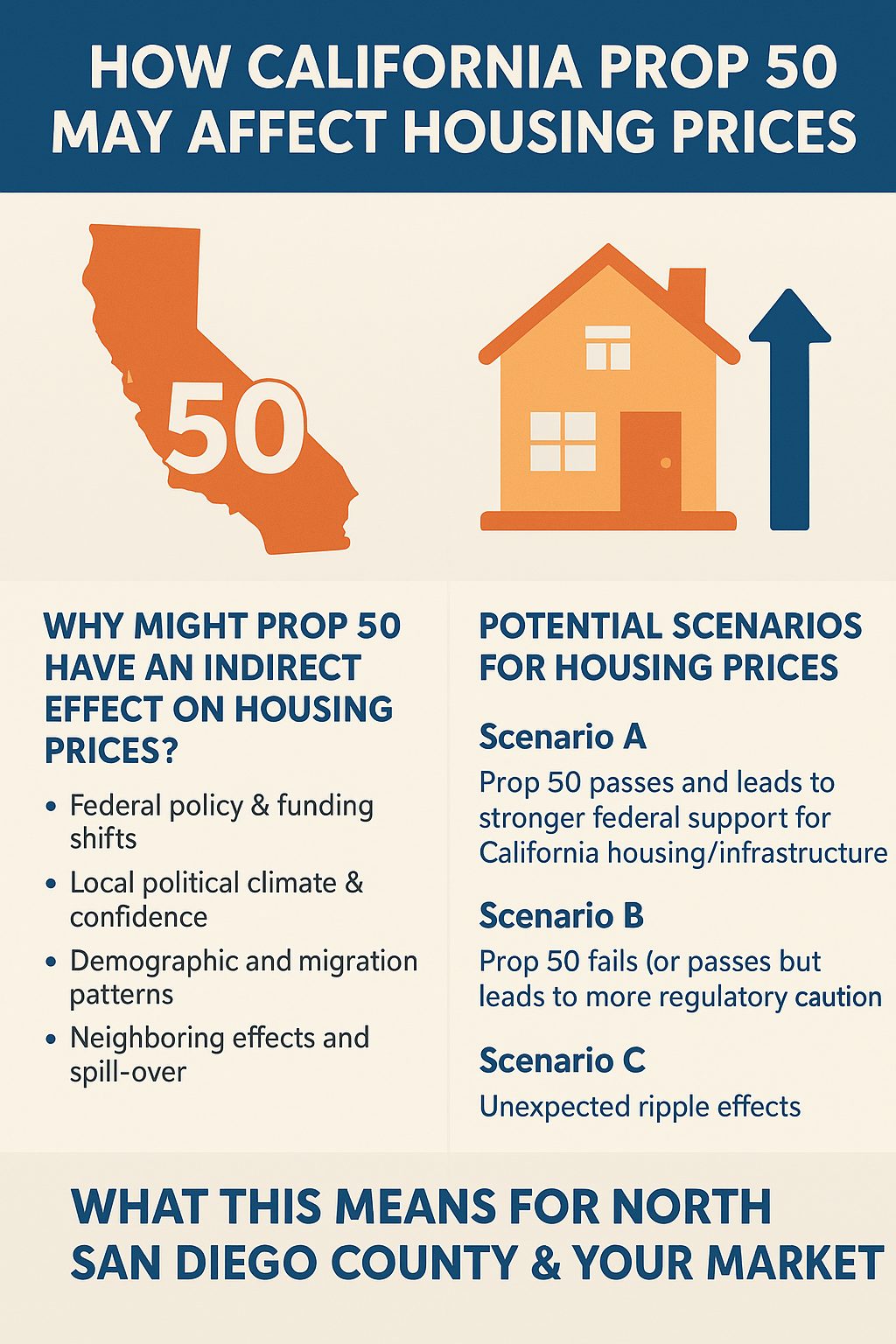
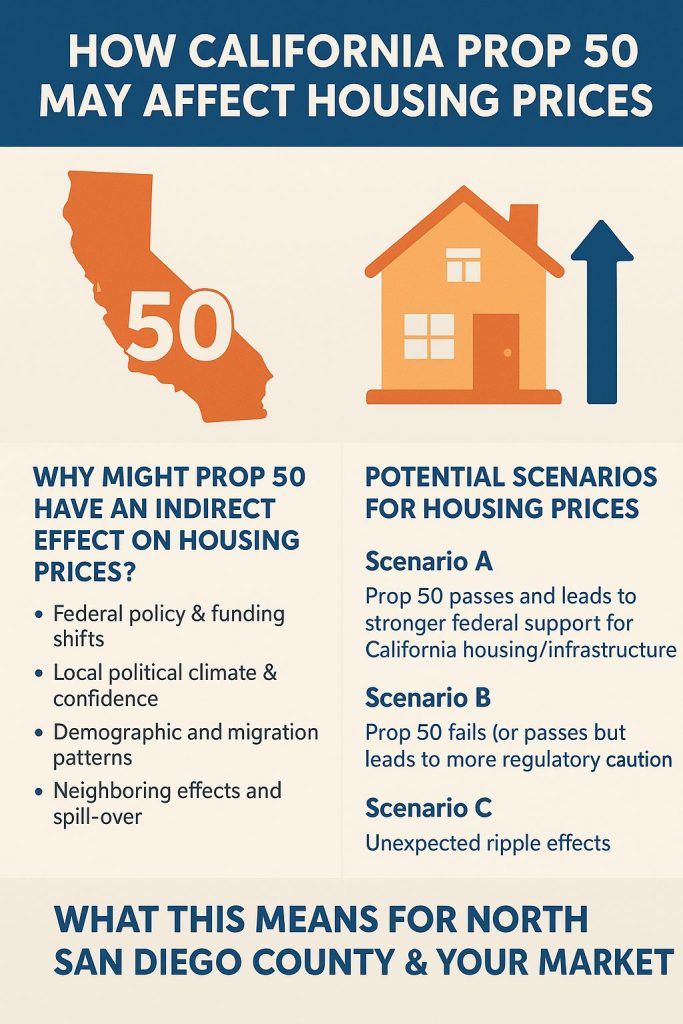
Why might Prop 50 have an indirect effect on housing prices?

Even though Prop 50 doesn’t directly regulate housing or property taxes, changes in political representation and policy can trickle into the housing market. Here are mechanisms to consider:

  1. Federal policy & funding shifts
    • Congressional representation affects how California’s interests are advanced in Washington — e.g., infrastructure funding, disaster relief, affordable housing grants, tax-policy decisions.
    • If Prop 50 results in a map that shifts power (for one party or another), that could influence federal spending or regulatory posture affecting housing supply, insurance, and tax incentives which ultimately impact housing demand and supply.
  2. Local political climate & confidence
    • Real-estate markets are sensitive to expectations about growth, migration, tax policy, land-use policy and regulatory risk. If voters believe that political power will shift in ways that favor more development, or conversely more restrictions, that can influence investor sentiment and buyer demand.
  3. Demographic and migration patterns
    • The drawing of congressional districts may highlight or shift emphasis on certain communities (for example, places of high growth, younger population, etc.). Over time this may correlate with trends in housing demand in those areas, especially if representation leads to different prioritisation of infrastructure or services.
  4. Neighboring effects and spill-over
    • While Prop 50 is statewide, some regions of California (including North San Diego County) may feel indirect effects: if statewide policy shifts (taxation, regulation) or if the overall investment climate changes, regional housing prices may respond.

So in short: the effect is indirect and likely modest and gradual. But as a real-estate professional you can position yourself to monitor these links, especially since California’s housing market is sensitive to policy changes.


Potential Scenarios for Housing Prices

Here are a few plausible scenarios — keeping in mind the speculative nature.

Scenario A: Prop 50 passes and leads to stronger federal support for California housing/infrastructure

  • If the new maps favour a party aligned with heavier investment or regulatory easing in housing/land-use, one could expect increased supply (e.g., more development approval, greater infrastructure funding) → This could moderate price growth (or slow the appreciation) as supply improves.
  • Simultaneously, stronger infrastructure and services could boost demand in particular sub-markets (e.g., near new development corridors) → localized price upticks.

Scenario B: Prop 50 fails (or passes but leads to more regulatory caution)

  • If the independent commission stays in place and the political status quo remains, perhaps policy changes are more incremental → housing prices may continue on their current trajectory, largely driven by supply constraints, migration, interest rates.
  • If sentiment becomes uncertain (because of partisan instability), then buyers might become more cautious, potentially slowing demand growth.

Scenario C: Unexpected ripple effects

  • For example, if the shift in congressional representation results in federal tax-law changes (capital gains, property tax, mortgage interest deduction) or major changes in disaster/insurance funding (wildfire risks, sea-level rise insurance) — these could have material effects in California housing markets (especially high-risk areas).
  • Regions like North San Diego County could benefit if, say, new policy spurs more housing development, improved transit, or more favourable insurance/regulation environment.

What this means for North San Diego County & your market

As someone working in real estate in North San Diego County, here are some take-aways:

  • Focus on local fundamentals: While Prop 50 is state-wide, your local market will still largely respond to factors like inventory, interest rates, regional job growth, migration from other states, land-use/development constraints.
  • Stay alert for policy shifts: If Prop 50 passes and leads to changes in federal funding for housing, infrastructure or disaster mitigation (which is relevant in California), you could anticipate new development or neighbourhood revitalisation in your area — that may drive upside price potential, particularly for early-moving buyers/investors.
  • Educate your clients: Many buyers/sellers may not understand the connection between congressional maps and housing markets. You can provide value by explaining that policy and representation can influence the real-estate ecosystem — even if indirectly.
  • Watch risk zones: California’s market has unique risk factors (wildfire, sea-level rise, insurance volatility). If policy changes stemming from representation affect how these risks are handled (federal disaster funding, insurance subsidies), that could shift value differentials across micro-markets (e.g., coastal vs inland, fire-prone vs less risky).
  • Marketing angle: If you anticipate that certain sub-markets will benefit from infrastructure investment or favourable policy change (post-Prop 50), you might highlight that in your listings/communications (e.g., “Positioned to benefit from upcoming federal infrastructure allocation”).
  • Timing matters: Changes in maps won’t immediately change housing supply/demand overnight. But over the next few years (2026-2030) you may see gradual shifts. Positioning early can give you an edge.

What won’t happen (or is unlikely)

  • Prop 50 by itself will not directly change local zoning, reduce property taxes, or immediately release large new tracts of housing supply.
  • It does not guarantee that housing prices will skyrocket (or crash) — many other forces dominate (interest rates, economy, migration, local land‐use policy).
  • Just passing Prop 50 doesn’t guarantee one party sweeping victory; campaigning, candidate quality, and turnout still matter.
  • Because the measure is about federal maps, its immediate tangible effect on your local real-estate market may be subtle rather than dramatic.

Key Takeaways for Blog Readers

  • Even though Proposition 50 isn’t a housing measure, it matters for housing — because representation and federal policy affect the broader ecosystem.
  • For buyers/sellers in North San Diego County: monitor how policy changes stemming from Prop 50 (if passed) could affect infrastructure, disaster funding, regulation, and hence local real-estate dynamics.
  • Advise clients that real-estate remains largely about fundamentals — supply/demand, rates, location — but policy overlay is the “hidden lever”.
  • Encourage clients to think 3-5 years ahead (to 2026-2030) rather than just immediate gains, since many effects play out over time.
  • Use your role as a trusted advisor to highlight how large state and federal political shifts can filter down to local housing markets, helping differentiate you in a competitive market.

Final Thoughts

In sum: Proposition 50 is not a game-changer for housing in the short term, but it may subtly shift the playing field over the medium term. As a real-estate professional you can turn this into an opportunity: by staying ahead of policy shifts, educating clients, and positioning your market accordingly. In California’s complex housing environment — especially in high demand regions like North San Diego County — being attuned to these indirect drivers can set you apart.


Steve Cardinalli
Real Estate Professional, 01323509
(760) 814-0248
Steve@Cardinalli.com
www.Cardinalli.com
Century 21 Affiliated Fine Homes & Estates
Village Faire in Carlsbad Village
300 Carlsbad Village Dr, 223
Carlsbad, CA 92008


Be the first to know about the market trend in your community at Neighborhood News


ChristmasHolidaySafetyThanksgiving November 3, 2025

Home Safety Tips for Holiday Travel: Protect Your Home While You’re Away

Home Safety Tips for Holiday Travel: Protect Your Home While You’re Away

The holiday season is a time for family, friends, and traveling to create lasting memories. But as you pack your bags and head out the door, it’s important not to overlook the safety of your home. Burglaries tend to spike during holidays, and even small accidents, like unattended candles or faulty lights, can lead to major issues. Here’s a guide to help ensure your home stays secure while you enjoy the season.

1. Lock Everything – Seriously

It may sound obvious, but double-check every door and window. Don’t forget less-used entrances like basement doors, sliding doors, or garage entry points. A sturdy deadbolt and secure window locks are your first line of defense.

2. Set Up Smart Home Devices

Smart technology can give the illusion that someone is home, even when you’re far away.

  • Smart lights: Program lights to turn on and off at varying times.
  • Security cameras: Real-time monitoring from your phone can alert you to any unusual activity.
  • Smart doorbells: See and speak to anyone approaching your door remotely.

3. Pause Mail and Deliveries

An overflowing mailbox or packages left on the doorstep are clear signs no one is home. Contact your local postal service to hold mail, and consider delaying any package deliveries until you return.

4. Don’t Overshare on Social Media

It’s tempting to post every holiday adventure, but sharing travel plans publicly can attract unwanted attention. Wait until after your trip to share your photos and updates.

5. Enlist a Trusted Neighbor or Friend

Ask a neighbor to keep an eye on your home while you’re away. They can collect mail, water plants, and report anything suspicious.

6. Secure Valuables

Store jewelry, cash, and important documents in a safe or offsite storage. Consider taking small, irreplaceable items with you rather than leaving them behind.

7. Mind Fire Hazards

If you’re leaving decorations like candles or lights behind, ensure they’re turned off before you leave. Faulty or unattended lights can start fires even if you’re miles away.

8. Use Timers and Motion Sensors

Timers for lights, holiday decorations, and indoor lamps, combined with motion sensor lights outside, create the appearance of activity, discouraging potential intruders.

9. Maintain Your Home’s Exterior

Keep your yard trimmed and driveway clear. Overgrown bushes or unshoveled snow (depending on your location) can signal that a home is unattended.

10. Create an Emergency Plan

Share your travel plans with a trusted friend or neighbor and provide emergency contact information. Ensure that you have remote access to your home security system if available.


Bottom Line

Holiday travel should be a joyful time, not one shadowed by worry about your home. By taking these precautions, you can leave confidently, knowing that your home is safe and secure. A few simple steps—locks, smart devices, trusted neighbors, and careful planning—can make a huge difference.


Be the first to know about the market trend in your community at Neighborhood News


Daylight SavingsSeasonal November 2, 2025

How Daylight Savings Time May Affect Real Estate

How Daylight Savings Time May Affect Real Estate

Every spring and fall, Daylight Savings Time (DST) rolls around—changing our clocks, our sleep patterns, and even the rhythm of our daily routines. While it may seem like just a minor seasonal shift, DST actually has some interesting impacts on the real estate market, especially in competitive housing areas like Southern California.


Here’s how the time change can influence buying, selling, and showing homes.

More Daylight Can Boost Buyer Activity

In the spring, when we “spring forward” and gain an extra hour of evening sunlight, it becomes much easier for buyers to tour homes after work. Longer daylight hours can:

Increase weekday showings

Encourage more weekend open house traffic

Improve curb appeal—homes simply look better in natural light

This often aligns with the traditional spring real estate surge, helping listings gain traction faster.


🌙 Shorter Days Can Slow Buyer Momentum

In the fall, when we “fall back,” afternoons get darker quicker, which can affect buyer behavior:

Fewer evening home tours

Reduced foot traffic at open houses

Lower visibility for drive-by buyers scouting neighborhoods

Homes may feel colder or darker in the evenings, which can also impact first impressions.


💡 Lighting & Staging Matter More During DST

As daylight changes, proper home lighting becomes even more important:


Bright, warm lighting creates a welcoming environment

Outdoor lighting boosts evening curb appeal and safety

Smart lighting timers ensure lights turn on before showings

Sellers should consider updating bulbs, adding accent lights, and opening blinds to maximize natural light.


🚗 Traffic & Commute Perception Can Shift

With DST changes, road and traffic patterns shift—especially after work hours. A neighborhood that feels quiet during long summer evenings might feel darker and more congested in fall. Buyers who commute may evaluate neighborhoods differently based on season.


🌅 Neighborhood Lifestyle Shifts

More daylight means more visible community activity—kids playing, neighbors walking dogs, evening joggers. This vibrancy can help buyers connect to the lifestyle a neighborhood offers. When evenings get darker earlier, that energy is less visible, potentially influencing perception.


🏠 Seasonal Selling Strategy Tips

For Sellers:

List in spring if possible to leverage natural light and buyer momentum

Improve lighting and landscaping for fall and winter listings

Showcase cozy, warm interiors during darker months


For Buyers:

View homes at different times of day to see true light and traffic patterns

Don’t judge a home solely by its lighting—ask about orientation and natural light

Consider that darker evenings can help you see how safe and well-lit a neighborhood really is

🌞 Bottom Line

Daylight Savings may only happen twice a year, but the shift in daylight hours can influence homebuyer behavior, showing schedules, curb appeal, and neighborhood perception. Whether buying or selling, being mindful of lighting and timing can create an edge in the real estate market.


If you’re thinking about selling your home—or want to find the right place to call home year-round—I’m happy to help strategize around market timing and seasonal trends. Let’s connect!


Steve Cardinalli
Real Estate Professional, 01323509
(760) 814-0248
Steve@Cardinalli.com
www.Cardinalli.com
Century 21 Affiliated Fine Homes & Estates
Village Faire in Carlsbad Village
300 Carlsbad Village Dr, 223
Carlsbad, CA 92008


Be the first to know about the market trend in your community at Neighborhood News


HalloweenHoliday October 31, 2025

Does Halloween Affect Real Estate?

Does Halloween Affect Real Estate?

Halloween is a holiday filled with costumes, candy, and spooky decorations—but could it also influence the real estate market? While it may seem unrelated, this festive season can actually have subtle effects on buying and selling homes.

First Impressions Matter

When a potential buyer visits a home, first impressions are everything. A house decked out with elaborate Halloween decorations can either charm or repel. Some buyers may love the festive spirit, imagining themselves celebrating holidays there, while others may find over-the-top displays distracting or even off-putting. Sellers should aim for tasteful décor that enhances the home’s charm rather than overshadowing it.

Curb Appeal and Seasonal Context

Halloween often encourages homeowners to spruce up their yards with pumpkins, lights, and seasonal landscaping. These improvements can enhance curb appeal, which is crucial in real estate. A well-maintained, seasonally decorated exterior can make a home feel inviting and memorable to potential buyers. Conversely, neglected yards or excessive clutter during the season can create a negative impression.

Timing and Market Activity

In many markets, fall is a transitional period. Buyers and sellers may be less active compared to the busy spring and summer months. Halloween can act as a subtle pause, where families are more focused on festivities than house hunting. However, real estate agents can use this time creatively, hosting themed open houses or events to draw attention to listings.

Psychological Impact

Holidays like Halloween can also influence the emotions of buyers. Homes that evoke warmth, community, and a sense of fun can create positive emotional connections. This can sometimes translate into quicker decisions or higher offers, as buyers feel drawn to the lifestyle a property represents—not just the physical structure.

Tips for Sellers Around Halloween

  • Keep decorations tasteful and avoid clutter.
  • Ensure walkways and entrances are safe and accessible for visitors.
  • Consider seasonal staging that highlights the home’s charm without overwhelming it.
  • Use the holiday as a marketing opportunity—creative photos and events can attract attention.

Bottom Line:
While Halloween may not drastically change home values, it can subtly impact buyer perception and engagement. Sellers who strike the right balance between festive fun and professional presentation may find their homes more appealing—and memorable—during the spooky season.


Steve Cardinalli
Real Estate Professional, 01323509
(760) 814-0248
Steve@Cardinalli.com
www.Cardinalli.com
Century 21 Affiliated Fine Homes & Estates
Village Faire in Carlsbad Village
300 Carlsbad Village Dr, 223
Carlsbad, CA 92008


Be the first to know about the market trend in your community at Neighborhood News


Market ConditionMarket TrendsReal Estate News October 25, 2025

Real Estate Blog – Late October 2025 Insights


Real Estate Blog – Late October 2025 Insights

Hello from sunny North San Diego County! As a real estate professional here in the region, I’m seeing how national trends are filtering down locally — so let’s unpack what’s happening and what it could mean for our local market.

1. Homeownership just dipped

Recent data shows the number of U.S. homeowners fell from about 86.28 million in 2024 to 86.19 million in 2025 — the first drop in nearly a decade.
Key drivers: rising mortgage and borrowing costs, home-price inflation, younger buyers delaying major decisions, and more renters.
Why this matters locally:

  • With fewer new homeowners entering the market, we may see increased demand in the rental space — and potential for investors to target rental properties.
  • As more people rent longer, neighborhood dynamics shift: more demand for well-kept rentals and multi-family units.
  • For sellers, this may reduce competition from first-time buyers; for buyers, it signals an affordability constraint.

2. Mortgage rates are easing — but the wind is still in the sails of inflation & data disruption

According to current reports:

  • Average 30-year fixed mortgage rate recently dropped to ~6.19%.
  • A soft inflation print (CPI ~3% annual) gave hope of rate cuts by the Federal Reserve.
  • However — a looming complication: the 2025 federal government shutdown has impacted key economic data releases (including CPI for October), which means less clarity for policy decisions.
    Local takeaways:
  • Lower mortgage rates (or the expectation of them) can ignite buyer interest — good news if you’re listing homes in North San Diego County.
  • Still, with affordability tight and inventory restrained, potential buyers may need creative financing or strategic timing.
  • Because the data environment is murky, there’s some uncertainty around future rate cuts — so guiding clients with conservative assumptions is wise.

3. Inventory, price growth and local opportunity

National commentary suggests:

  • Inventory is increasing modestly, which is helping moderate price growth.
  • Many markets are experiencing prices that are flat or barely up when adjusted for inflation.
  • Experts expect a slow recovery in sales volumes and modest price appreciation through 2026.
    What this means for North San Diego County:
  • If local inventory begins to loosen (more homes entering market), sellers may need to temper expectations for large price jumps — listing strategy and presentation become more critical.
  • For buyers: this is a window of opportunity — less frenetic bidding wars, more negotiation room, and better selection than during peak frenzy years.
  • For investors: with price growth slower, the emphasis may shift toward rental yield, value-add opportunities, and long-term hold rather than rapid flip-style gains.

4. Strategy recommendations for your business & clients

Since you’re active in the local real estate market, here are a few action-items to consider:

For sellers:

  • Highlight affordability and rate reduction potential — show how monthly payments compare under current scenarios.
  • Emphasize home condition, staging, and differentiating features — when price growth is more modest, presentation counts.
  • Educate sellers that the market may no longer be hyper-heated; timely listing and aggressive marketing may still capture premium but timing matters.

For buyers:

  • Bookmark current rate trends and set realistic budgets. If mortgage rate could drop further, gauge when it makes sense to act versus waiting.
  • Explore adjustable-rate mortgages, buy-downs, or other structures if rates are still elevated.
  • Align with a lender early so you’re ready when a quality listing hits — supply may improve, but the best ones will attract attention.

For investors:

  • With price growth moderating, look for properties where cash-flow potential is strong — especially in multi-family or value-add segments.
  • Monitor rental market trends in your region: as homeownership drops, rental demand may pick up.
  • Stay aware of macro risks: if data disruption or policy surprises arise (e.g., slower rate cuts), it could impact borrowing costs or demand.

5. Looking ahead — what to watch

Keep an eye on these upcoming signals which could shift the local market:

  • The next CPI and inflation readings once data disruptions settle.
  • Mortgage rate movement — if rates drop meaningfully, buyer demand could accelerate.
  • Changes in inventory levels locally — new listings, days-on-market, price reductions.
  • Rental vacancy and rent-growth trends — especially given the homeownership dip.
  • Local migration patterns: North San Diego County continues to attract people from higher-cost California markets; affordability changes upstream could shift this.

Bottom line:
We’re in a phase of moderation and measured opportunity. The hyper-growth era may have passed (for now), replaced by a “steady growth, smarter strategy” environment. Buyers, sellers and investors can all find wins — but the rules of competition have shifted.


Steve Cardinalli
Real Estate Professional, 01323509
(760) 814-0248
Steve@Cardinalli.com
www.Cardinalli.com
Century 21 Affiliated Fine Homes & Estates
Village Faire in Carlsbad Village
300 Carlsbad Village Dr, 223
Carlsbad, CA 92008


Be the first to know about the market trend in your community at Neighborhood News


AssessedAssessorProperty Value October 24, 2025

You May Be Able To Reduce Your Assessed Real Estate Value

If you own property in San Diego County and believe the assessed value is too high, here are the main steps and options you can use to try to reduce your property’s value (and thus your taxes). I’ll walk you through the process and things to consider.


✅ 1. Understand the key laws and concepts

  • Under California Proposition 13 (1978): your property’s “factored base year value” means your assessed value is based on the purchase price (or change of ownership/new‐construction value) plus up to a 2% inflation increase per year (until there is change of ownership/new construction).
  • Under California Proposition 8: if the market value of your property falls below your assessed value as of the lien date (January 1), the assessor must enroll the lesser of (a) the factored base year value or (b) the market value.
    • This means you can request a “decline in value” review.
  • In San Diego County:
    • You can appeal the assessment with the Assessment Appeals Board of San Diego County.
    • You also can ask the assessor informally for reconsideration.
  • Exemptions: e.g., the Homeowners’ Exemption gives a $7,000 reduction in taxable value for a principal residence.

📝 2. Determine why you believe your assessed value is too high

Ask yourself questions like:

  • Is the market value of similar homes lower than my assessed value?
  • Are there physical issues with my property (damage, deferred maintenance) that reduce value?
  • Did the assessor use incorrect data (incorrect size, amenities, etc.)?
  • Has there been new construction or change that concerned me?

You’ll need evidence: comparable sales, recent appraisals, photos, etc.


📆 3. Identify the correct deadline for filing an appeal

  • For the normal annual assessment (lien date January 1), in San Diego County the filing window with the Assessment Appeals Board runs typically from July 2 to December 1 (or early December).
  • For a supplemental assessment (e.g., after a change of ownership or new construction), if you receive a supplemental bill you must file within 60 days of that bill or notice.

📄 4. How to file the appeal

Here’s a step-by-step outline for San Diego County:

  1. Review your Notice of Assessed Value from the San Diego County Assessor/Recorder/County Clerk and make sure all the data is correct.
  2. Gather supporting documentation: comparable sales, condition evidence, appraisal, photos.
  3. Obtain the correct appeal form: see the forms page for the Assessment Appeals Board.
  4. Fill the form out and submit it (mail or in person) by the deadline. For example: mail to “Clerk of the Board of Supervisors, Assessment Appeals, 1600 Pacific Highway, Room 402, San Diego, CA 92101‐2471”.
  5. Attend your hearing: you will present your evidence to the Board. The Board may reduce, affirm, or increase the assessment (though if you’re appealing typically you hope for a reduction).

🚩 5. Tips to improve your chances

  • Make sure you compare to similar properties (location, size, age, condition).
  • Emphasize things that reduce market value (damage, obsolescence, lot problems).
  • Make sure there are no errors in the assessor’s records (square footage, number of bedrooms, amenities).
  • Consider discussing the value with an appraiser ahead of time.
  • Be timely – missing deadlines will disqualify you.
  • Stay calm and factual at the hearing—focus on market value evidence.

Steve Cardinalli
Real Estate Professional, 01323509
(760) 814-0248
Steve@Cardinalli.com
www.Cardinalli.com
Century 21 Affiliated Fine Homes & Estates
Village Faire in Carlsbad Village
300 Carlsbad Village Dr, 223
Carlsbad, CA 92008


Be the first to know about the market trend in your community at Neighborhood News


Death on a PropertyDisclosure October 22, 2025

Understanding the Legal Requirements for Reporting a Death on a Property in California

🏠 Understanding the Legal Requirements for Reporting a Death on a Property in California


When selling a home in California, one of the most common questions that arises—especially from buyers—is: “Does the seller have to disclose if someone died in the house?” Deaths in a property can raise emotional, cultural, and even financial concerns for potential buyers. As a seller or real estate professional, it’s essential to understand the state’s disclosure laws to stay compliant and maintain transparency.


California’s Disclosure Law on Deaths in Property

Under California Civil Code §1710.2, sellers (and their agents) are legally required to disclose any death that occurred on the property within the past three years.
This applies regardless of whether the death was from natural causes, an accident, suicide, or homicide.

The key points are:

  • Three-Year Rule: Any death that took place within three years prior to the sale must be disclosed to potential buyers.
  • How to Disclose: The disclosure should be made in writing and typically included as part of the seller’s disclosure statements (such as the Transfer Disclosure Statement or Seller Property Questionnaire).
  • Agent Responsibility: Real estate agents must ensure that the seller provides this information to buyers and should never attempt to conceal such facts.

Deaths Older Than Three Years

If a death occurred more than three years ago, California law does not require the seller to volunteer that information.
However, if a buyer specifically asks whether anyone has ever died on the property—no matter how long ago—it’s legally required that the seller and agent answer truthfully.
Failing to do so could be considered fraudulent concealment and may result in legal action later.


Exceptions for Sensitive Circumstances

Sellers are not required to disclose if the death involved someone with HIV/AIDS or other related illnesses, as this information is protected under California’s anti-discrimination and privacy laws.


Why Disclosure Matters

Being upfront about a death on the property:

  • Builds trust between buyers and sellers.
  • Reduces the risk of future lawsuits or accusations of misrepresentation.
  • Ensures compliance with California real estate law.
  • Helps maintain the integrity of the transaction.

Best Practices for Sellers and Agents

  1. Be Honest and Transparent: Always err on the side of disclosure when in doubt.
  2. Document Everything: Put disclosures in writing and keep copies for your records.
  3. Prepare for Buyer Reactions: Some buyers may be uncomfortable, while others may not care. Transparency helps manage expectations early.
  4. Consult a Real Estate Professional: An experienced local agent can guide you through the disclosure process and ensure all forms are properly completed.

Final Thoughts

Selling a home in California comes with a responsibility to provide accurate and honest information—including whether a death occurred on the property in the past three years. While this can sometimes feel uncomfortable to discuss, following the law and maintaining transparency ultimately protects everyone involved in the transaction.

If you’re considering selling your home or have questions about disclosure requirements, I can help guide you through the process.
👉 Find out your home’s current value here.


Steve Cardinalli
Real Estate Professional, 01323509
(760) 814-0248
Steve@Cardinalli.com
www.Cardinalli.com
Century 21 Affiliated Fine Homes & Estates
Village Faire in Carlsbad Village
300 Carlsbad Village Dr, 223
Carlsbad, CA 92008


Be the first to know about the market trend in your community at Neighborhood News


Community PropertyCommunity Property with Right of SurvivorshipHolding Title in a Living TrustJoint Tenancy with Right of SurvivorshipTenancy in CommonTitle October 20, 2025

Different Ways a Married Couple Can Hold Title in Real Estate

Different Ways a Married Couple Can Hold Title in Real Estate

When a married couple purchases a home, one of the most important — and often overlooked — decisions they’ll make is how to hold title to the property. The way title is held affects ownership rights, inheritance, and potential tax implications. Here’s a breakdown of the most common ways married couples can hold title in real estate, particularly in California and similar community property states.


1. Community Property

In community property states like California, any property acquired during marriage is presumed to be owned equally by both spouses. This means each spouse owns 50% of the property, regardless of who earned the income or signed the purchase documents.
Pros:

  • Equal ownership rights.
  • Clear rules for dividing assets in the event of divorce.
    Cons:
  • Without additional provisions, the deceased spouse’s share must go through probate.

2. Community Property with Right of Survivorship

This option combines the benefits of community property with the simplicity of avoiding probate. When one spouse passes away, the surviving spouse automatically becomes the sole owner.
Pros:

  • Avoids probate.
  • Maintains community property tax benefits, including a full step-up in basis upon the death of one spouse.
    Cons:
  • Not as flexible for estate planning involving children or trusts.

3. Joint Tenancy with Right of Survivorship

In joint tenancy, both spouses own equal shares of the property, and when one dies, the surviving spouse automatically inherits the other’s share.
Pros:

  • Bypasses probate.
  • Simple and common method for married couples.
    Cons:
  • Does not provide the same tax benefits as community property.
  • Each spouse’s share can be affected by creditors or separate legal judgments.

4. Tenancy in Common

This method allows each spouse to own a specific percentage of the property, which doesn’t have to be equal. Each owner’s share can be sold, gifted, or passed down to heirs independently.
Pros:

  • Flexibility in ownership shares and inheritance.
  • Useful for blended families or business partnerships.
    Cons:
  • No right of survivorship — the deceased spouse’s share must go through probate.

5. Holding Title in a Living Trust

A couple can also hold title through a revocable living trust, which allows for seamless management and transfer of property upon death or incapacity.
Pros:

  • Avoids probate.
  • Offers flexibility and privacy.
  • Can include customized inheritance instructions.
    Cons:
  • Requires proper setup and ongoing maintenance.

Final Thoughts

Choosing how to hold title is more than just a paperwork detail — it can have long-term consequences for taxes, inheritance, and ownership rights. Because every couple’s financial and family situation is unique, it’s always wise to consult with a real estate attorney, tax advisor, or estate planning expert before deciding how to take title. The right choice today can help prevent costly legal complications tomorrow.


Steve Cardinalli
Real Estate Professional, 01323509
(760) 814-0248
Steve@Cardinalli.com
www.Cardinalli.com
Century 21 Affiliated Fine Homes & Estates
Village Faire in Carlsbad Village
300 Carlsbad Village Dr, 223
Carlsbad, CA 92008


Be the first to know about the market trend in your community at Neighborhood News


LocationNear the OceanOcean FrontOcean View October 17, 2025

Does an Ocean View Add Value in San Diego County?


Does an Ocean View Add Value in San Diego County?

Short answer: yes, in many cases an ocean view does substantially increase property values in San Diego County. But how much it adds depends on a lot of factors: distance from the water, how unobstructed the view is, elevation, whether it’s oceanfront vs just a view, neighborhood prestige, risks (sea‐level, noise, etc.), and so on.

Below is a breakdown of what the research and market data suggest.


What Studies Tell Us: The Coastal Premium in San Diego

One particularly relevant study is “An Estimation of the Coastal Premium for Residential Housing Prices in San Diego County” (2009). In that study:

  • The authors looked at ~9,755 home sales in 2006, controlling for structural and locational factors.
  • They found that homes very close to the coast had large premiums: for example, homes within 500 feet of the coastline were about 101.9% more valuable than similar homes more than six miles from the coast.
  • The premium dropped off rapidly with distance. Between 500-1,000 feet distance, premium was about 62.8%; between 1-2 miles, about 21.3%. Beyond 6 miles, the “coastal premium” largely disappears.

So, proximity to the ocean (or the coast) clearly has measurable value in the San Diego market, especially for homes that are very close or have unobstructed views.


How Big Is the Premium, Generally?

Other data points help us understand typical premiums for ocean or water views, though not always specific to San Diego.

  • A California‐wide study (from The Real Deal) found that buyers paid on average about 15% more for homes with ocean views compared with homes “close to the water but without the view.”
  • Another report (LA Focus, citing multiple California cities) puts San Diego at around a 34% premium for homes with ocean views, for homes priced around $1.4 million — i.e. buyers in that price range are often willing to pay ~$361,000 more for view vs no view.
  • At the high end (luxury oceanfront in Del Mar, La Jolla, etc.), the price per square foot for oceanfront homes can be quite high ($4,000-$6,000/sq ft in Del Mar for oceanfront). Homes with sweeping ocean views (not necessarily beachfront) also command premium pricing.

What Affects How Much Value an Ocean View Adds

Here are some of the key levers that influence how much premium a view gives:

Factor How It Matters
Proximity to Pacific / coastline Being beachfront or within a few hundred feet vs being a mile or more away makes a big difference. The closer, especially within 0-500 ft, the bigger the premium.
Elevation and line‐of‐sight / unobstructed view A house up on a bluff, with wide unobstructed vista, will be worth more than one whose view is partly blocked by other houses, trees, or terrain.
Orientation West facing (toward sunsets over Pacific), large windows, balconies all enhance view value.
Prestige of neighborhood Ocean view in elite or high‐end neighborhoods tends to generate larger percentage increments, because base price is already high. For example, Del Mar, La Jolla, etc.
Risk and cost factors Erosion, flood risk, insurance costs, maintenance from exposure (salt, wind) can eat into the perceived upside. Buyers may discount for these risk factors.
Supply and exclusivity Fewer lots with ocean view, limited oceanfront supply, scarcity drives up premiums. If many houses in an area have views, premium may be lower.

What “Ocean View” vs “Oceanfront” vs “Near the Ocean” Mean

It’s useful to differentiate these:

  • Oceanfront: direct contact with beach or coastline; typically highest premium.
  • Ocean view: view of the ocean from the property, which may be elevated or set back, possibly partially obstructed.
  • Near the ocean / coastal proximity: physically close to the coast but may not have direct view, or views may be blocked.

The premium tends to be highest for oceanfront, followed by ocean view, then just proximity. The San Diego study showed that even being near but not directly at the ocean has value, but the premium drops steeply with distance.


Recent Market Examples

  • Homes in Ocean Beach have median values over $1.2 million, reflecting both demand for proximity to ocean + views.
  • Del Mar oceanfront homes have sold in very high price ranges (e.g. ~$18.9 million for a ~2,700 sq ft beachfront home) in recent times.

These provide concrete illustrations of how ocean views (and especially oceanfront) push prices into luxury territory.


Caveats & Things to Watch Out For

While ocean views often help, they don’t guarantee “maximum upside.” Here are some caveats:

  • Obstruction risk: New development, tree growth, zoning changes above the property could block views in future; that risk sometimes shows up in pricing.
  • Climate / regulation risk: Coastal erosion, rising sea levels, stricter building codes (for flood zones, wind, etc.), higher insurance costs, and view‐blocking buffer zones can all hurt value or increase ownership cost.
  • Maintenance / wear & tear: Salt air, moisture and storms can increase maintenance, corrosion, landscaping challenges, etc. That adds cost. Buyers might discount for that.
  • Buyer preference variation: Not every buyer values views equally. Some buyers care more about interior, layout, amenities. Also, view features may come at expense of lot size or other features.
  • Diminishing returns: After a certain point, further “improvement” in view might add less and less. For example, moving from a partially obstructed view to fully unobstructed adds value, but once it’s already oceanfront with panoramic views, incremental improvements (bigger windows, nicer finishes) might show smaller percent gains.

What This Means for Buyers and Sellers

For Sellers:

  • If you have an ocean view (or could create/improve one via landscaping, window placements, decks etc.), it’s very likely worth investing in staging to highlight the view.
  • Make sure view is well documented, get photos, ideally produce comps (“comparable homes”) with and without views.
  • Be aware of costs (insurance, maintenance) that a more sophisticated buyer may factor in — get ahead of those.

For Buyers:

  • Be willing to pay the premium only if the view is important to you, because you may be paying substantially more.
  • Consider future view risks (new construction, trees, zoning).
  • Assess ongoing costs (insurance, exposure, etc.).
  • Compare similar homes (same neighborhood, lot size, square footage) with and without view to see whether the premium is reasonable or inflated.

Conclusion

In San Diego County, an ocean view (especially if unobstructed, close to shore, elevated, and in a desirable neighborhood) is a powerful value booster. The “coastal premium” can be very substantial — over 100% more in some cases for homes immediately adjacent to the coast, dropping off steeply with distance. But it’s not a free lunch: risk, cost, and buyer preferences can mitigate how much of that premium is realized.

If you like, I can pull together some recent comps (homes sold in San Diego County in the last 12 months) comparing with/without ocean view to see current real premiums — might help you see what’s realistic right now. Do you want me to assemble that?


Steve Cardinalli
Real Estate Professional, 01323509
(760) 814-0248
Steve@Cardinalli.com
www.Cardinalli.com
Century 21 Affiliated Fine Homes & Estates
Village Faire in Carlsbad Village
300 Carlsbad Village Dr, 223
Carlsbad, CA 92008


Be the first to know about the market trend in your community at Neighborhood News