Loans and LendersMoney Saving TipsPMI Private Mortgage Insurance October 16, 2025

What is PMI and How Do I Get it Removed?

PMI stands for Private Mortgage Insurance. It’s typically required by lenders when you take out a conventional loan and put down less than 20% of the home’s purchase price as a down payment. PMI protects the lender in case you default on the loan.

How to know if you’re paying PMI:

Check your mortgage statement: Your lender or servicer should clearly list any PMI premiums on your monthly mortgage statement.

Ask your lender: If you’re unsure whether you’re paying PMI, you can contact your lender directly and ask.

Look at your loan agreement: PMI details, including cost and terms, should be outlined in the original loan paperwork.

How to get PMI removed:

Reach 20% equity: Once you’ve paid down your mortgage to where you owe less than 80% of the home’s current value, you can request that PMI be removed.

Automatic removal: Lenders are required by law to automatically remove PMI when the loan balance reaches 78% of the home’s original value, based on the original purchase price, but this might not always happen immediately after reaching that threshold.

Refinance: If you’ve built up significant equity (or if home values in your area have risen), you could refinance your mortgage to eliminate PMI, especially if your loan-to-value ratio is below 80%.

Request it in writing: If you believe you’ve reached 20% equity, you can formally request PMI removal. Your lender may require an appraisal to confirm the current value of your home.

Just keep in mind that different lenders may have different processes, so it’s a good idea to check with your lender for the exact steps specific to your mortgage.


Steve Cardinalli
Real Estate Professional, 01323509
(760) 814-0248
Steve@Cardinalli.com
www.Cardinalli.com
Century 21 Affiliated Fine Homes & Estates
Village Faire in Carlsbad Village
300 Carlsbad Village Dr, 223
Carlsbad, CA 92008


Be the first to know about the market trend in your community at Neighborhood News


Loans and LendersMoney Saving TipsProperty TaxReverse MortgageSeniorsToye Martindale October 14, 2025

How California Seniors Can Save on Real Estate Taxes

How California Seniors Can Save on Real Estate Taxes

For many California seniors, property taxes can be one of the largest expenses of homeownership — especially after retirement when income often becomes fixed. Fortunately, there are several programs and strategies designed to help seniors reduce or defer their property tax burden while staying in their homes longer.


1. Take Advantage of Proposition 19

Proposition 19, which took effect in 2021, offers one of the most valuable property tax breaks for seniors 55 and older. It allows eligible homeowners to transfer their property tax base to a new home anywhere in California — up to three times in a lifetime.

  • Example: If you sell a home assessed at $400,000 and buy a new one for $700,000, your new tax bill will be based on your original assessment plus the difference in price — not the full market value.
    This can save thousands each year.

2. Apply for the Property Tax Postponement (PTP) Program

California’s State Controller’s Office runs the Property Tax Postponement Program, which allows qualifying seniors (age 62 and older), the blind, or the disabled to defer property taxes on their primary residence.

  • To qualify, you must meet certain income and equity limits.
  • The deferred taxes become a lien on the property and are repaid when the home is sold.

This is an excellent option for seniors on fixed incomes who want to free up cash flow without selling their home.


3. Claim the Homeowners’ Exemption

Every homeowner in California is eligible for the Homeowners’ Exemption, which reduces the taxable value of your primary residence by $7,000. It’s simple to apply through your county assessor’s office and can save about $70 annually.

While modest, every bit helps — and many homeowners forget to file this exemption.


4. Look Into County Senior Tax Relief Programs

Some counties and cities in California offer local senior property tax assistance or additional exemptions. These vary by location, so it’s worth checking with your County Assessor’s Office or Tax Collector for programs that may apply in your area.


5. Consider a Reverse Mortgage for Tax Relief

While not a tax program, a reverse mortgage allows homeowners 62+ to tap into their home’s equity to cover expenses like property taxes without monthly payments. This can be a smart financial tool for some seniors, though it’s important to discuss the pros and cons with a qualified financial advisor.

Toye Martindale is a trusted reverse mortgage expert in San Diego’s North County.


6. Review Your Property Tax Bill for Errors

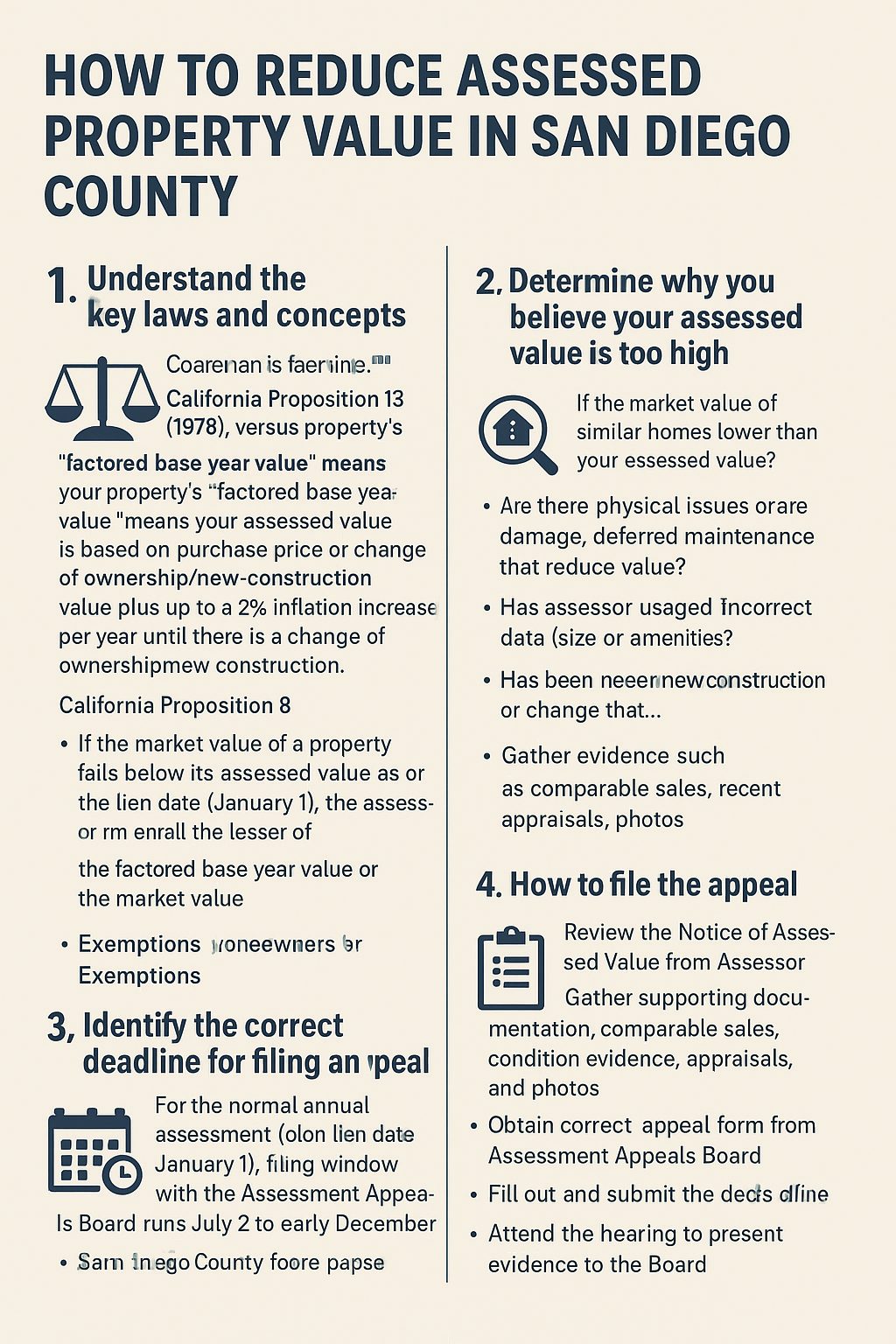
Assessors occasionally make mistakes. Seniors can appeal their property tax assessment if they believe their property’s value is overstated — which can lead to a lower annual tax bill. Each county provides a simple appeal process and filing deadlines.


Final Thoughts

California seniors have several options to lower or delay their real estate tax burden. Between Proposition 19, tax postponement programs, and local exemptions, you may be able to save thousands — and keep more of your hard-earned money for what truly matters: enjoying your home and retirement.


Steve Cardinalli
Real Estate Professional, 01323509
(760) 814-0248
Steve@Cardinalli.com
www.Cardinalli.com
Century 21 Affiliated Fine Homes & Estates
Village Faire in Carlsbad Village
300 Carlsbad Village Dr, 223
Carlsbad, CA 92008


Be the first to know about the market trend in your community at Neighborhood News


GovernmentPoliticsU.S. Department of Housing and Urban Development (HUD) October 14, 2025

Recent job losses at HUD in the past two weeks


Recent job losses at HUD in the past two weeks

What the reports say

  • As of mid-October 2025, HUD has sent out layoff notices to 442 employees across the agency.
  • Among those, specific cuts are concentrated in divisions such as:
    • Fair Housing & Equal Opportunity: nearly 100 staffers received RIF notices, particularly in regional field offices.
    • Public & Indian Housing: ~103 employees
    • Office of Housing: ~86 employees
    • Community Planning & Development: ~30 employees
  • Also, HUD has already furloughed more than 75 % of its ~6,105 employees due to the federal government shutdown.
  • Some field offices (in cities like Atlanta, Baltimore, Boston, Denver, etc.) have reportedly shuttered or suspended operations.
  • It is unclear how many of the 442 notices will lead to actual separations versus being rescinded, delayed, or reversed.

So in the past two weeks, the currently best-publicized figure is 442 layoff notices at HUD. Whether all of those will become actual job losses is not yet confirmed.

Context and caveats

  • These layoffs are happening during a government shutdown, which complicates the distinction between furloughs and permanent terminations.
  • Many RIF notices list a “last day” as December 9, which suggests that the actual separations might not occur immediately.
  • Earlier in 2025, HUD had already lost an estimated 2,300 employees (about 23 % of its workforce) through resignations, retirements, or attrition under the current administration.
  • Some reports suggest entire divisions or field offices might be shut down or repurposed.

Projected further job losses at HUD

Based on current signals and budget plans, additional reductions seem likely, though there is uncertainty about magnitude and timing.

What planning documents and proposals suggest

  • In the FY 2026 budget plans, HUD is among the agencies proposing to cut more than 20 % of its workforce.
  • Some reports and analyses have projected that HUD’s workforce could be halved over time, especially under aggressive cost-cutting agendas that target field offices, program support, enforcement divisions, and administrative staff.
  • The Office of Community Planning & Development (which funds local affordable housing, homelessness, and community development programs) is slated for as much as an 84 % reduction in staff under one plan.
  • Some budget proposals and internal HUD documents reportedly target entire field offices for closure or consolidation.

What we might expect in coming weeks or months

Given the ongoing government shutdown and the slow rollout of RIF processes, here is a rough scenario:

Time frame Possible additional losses Notes / constraints
In next month Perhaps a few hundred more beyond the 442 already noticed Additional RIF notices may be issued, especially if shutdown continues
Over next quarter Up to 1,000–2,000 more in a worst-case, aggressive scenario If proposals to cut 20–50 % of staff are activated
Longer term (FY 2026 and beyond) Tens of thousands (relative to baseline) could be cut Driven by proposed staffing reductions (e.g. 20 %+ cuts) in HUD’s budget requests

But to emphasize: that longer-term projection depends heavily on Congressional approval, legal challenges, and internal agency decisions. Some cuts might be blocked, delayed, or scaled back.


What these cuts imply

  • Service disruption: As field offices close and staff are removed, HUD’s ability to process grants, inspect public housing, enforce fair housing laws, and support homelessness programs will be strained.
  • Backlogs and inefficiencies: Fewer staff means longer wait times for applications, delayed oversight, and less capacity for program monitoring.
  • Legal and policy risk: Some of the announced layoffs are being challenged in court, especially the use of RIFs during a shutdown.
  • Moral and institutional risk: Frequent reorganization, threats of termination, and program shifts may lead to further attrition, loss of institutional knowledge, and difficulty recruitment.

Steve Cardinalli
Real Estate Professional, 01323509
(760) 814-0248
Steve@Cardinalli.com
www.Cardinalli.com
Century 21 Affiliated Fine Homes & Estates
Village Faire in Carlsbad Village
300 Carlsbad Village Dr, 223
Carlsbad, CA 92008


Be the first to know about the market trend in your community at Neighborhood News


World Events October 13, 2025

Will the Hostage Release Move San Diego Real Estate?

Will the Hostage Release Move San Diego Real Estate?

When dramatic geopolitical events make headlines — hostage releases, ceasefires, wars ending — it’s natural to wonder if there will be knock-on effects even in “local” markets like real estate in San Diego. But the connection is likely to be weak, or at least delayed. Here is a breakdown of how—and how much—it could matter.


Mechanisms through which it might have an effect

To assess potential impacts, it helps to think through the channels by which such an event could influence housing markets:

  1. Investor confidence & risk perception.
    A successful diplomatic or peace development may slightly reduce geopolitical risk or global uncertainty. That might nudge broad investor sentiment upward. In turn, that could improve demand for “safe-ish” assets like real estate, particularly in stable, developed markets.
  2. Capital flows / foreign investment.
    If foreign investors feel more confident about global stability, they might be more willing to invest abroad (e.g. U.S. real estate). San Diego, with its coastal location, climate, and international ties, might get a share of that. But changes in foreign flows tend to be modest unless the broader investment climate shifts.
  3. Exchange rates, interest rates & monetary policy.
    If a geopolitical de-escalation contributes to easing in risk premia, global markets may react (rates, currencies). In the U.S., mortgage rates are a big driver of housing affordability and demand. So, if the event helps soften macro volatility, that could trickle into slightly lower rates or more stable credit conditions, indirectly benefiting real estate.
  4. Sentiment / psychology.
    Real estate is partly driven by confidence. If people feel more optimistic (jobs are secure, economy stable), they may be more likely to make big purchases. A positive international development might enhance that—but it competes with more dominant, local drivers (income, employment, supply constraints).
  5. Direct local impacts (probably minimal).
    Unless San Diego has some direct connection (e.g. many local residents or businesses tied to the region involved, or regulatory/migration changes linked to the event), the immediate local impact is likely negligible.

Why the effect would likely be small (or delayed)

In practice, several reasons suggest that the hostage release will not be a key driver of San Diego housing:

  • Local fundamentals dominate. Housing markets move on jobs, wages, supply, interest rates, zoning, demographics, and credit availability. Those factors will almost always overshadow a geopolitical event’s indirect influence.
  • Already existing market headwinds. In San Diego, and California broadly, the housing market is under strain from high mortgage rates, affordability constraints, limited supply, and cautious sellers. For example, new listings in San Diego have declined, and many sellers are pulling homes off the market rather than lowering price expectations.
  • Delayed or muted capital flows. Foreign and institutional investors often take time to adjust allocations. Moreover, they must compare many markets, regulatory environments, tax regimes, exchange rates, etc. A hostage release is unlikely to dramatically shift those calculus.
  • Risk of over-interpretation. It’s easy to see patterns where none exist. Real estate is sticky: trends can persist even when catalysts change.

What might happen in San Diego (plausible scenarios)

Here are some modest effects or paths one might watch, assuming a significant de-escalation or peace agreement unfolds:

  • Slight uplift in buyer interest / inquiries. Alongside improved sentiment, you might see more “window shopping,” more people considering moves they had been delaying.
  • Incremental foreign buyer pickup. San Diego already sees international and cross-border buyer interest. If confidence strengthens abroad, that interest might inch upward.
  • Refinancing / interest rate sensitivity. If the geopolitical de-risking contributes to easing interest rates, more borrowers might refinance or qualify for mortgage improvements, lowering monthly costs and enabling more buyers.
  • Delayed price stabilization. If demand strengthens slightly, it could help absorb inventory and prevent further downward pressure on home prices.
  • Segmented effect by price tier. Luxury or high-end properties (frequently bought by investors or buyers with diversified portfolios) might see more sensitivity to “macro” shifts. The middle or entry-level market will remain more tethered to local income and borrowing constraints.

What to watch

If you want to track whether this kind of event is making a real difference in San Diego real estate, these indicators are worth watching:

  • Mortgage interest rate trends
  • Volume of new listings vs. delistings
  • Days on market and absorption rates
  • Foreign / out-of-state buyer share
  • Price movements (median, by tier)
  • Local job growth, wage growth, consumer confidence

Also, check for commentary from local realtors and brokers—if they begin referencing increased buyer interest tied to improved global sentiment, that might hint at a nascent effect.


Conclusion

While the release of hostages and related geopolitical developments can affect global financial sentiment, their direct influence on a local housing market like San Diego is likely to be modest, indirect, and spread over time. Local economic fundamentals—jobs, wages, interest rates, inventory, and regulations—will remain the primary levers driving real estate outcomes.


Steve Cardinalli
Real Estate Professional, 01323509
(760) 814-0248
Steve@Cardinalli.com
www.Cardinalli.com
Century 21 Affiliated Fine Homes & Estates
Village Faire in Carlsbad Village
300 Carlsbad Village Dr, 223
Carlsbad, CA 92008


Be the first to know about the market trend in your community at Neighborhood News


Open House October 8, 2025

The Pros and Cons of Hosting an Open House

The Pros and Cons of Hosting an Open House

Open houses have long been a staple in real estate marketing. They offer buyers a chance to explore a home in person and sellers an opportunity to generate buzz and potential offers. But are open houses always worth it? Let’s look at the pros and cons to help you decide whether an open house is the right move for your property.


Pros of an Open House

1. Increased Exposure
An open house can attract a wide range of potential buyers, including those who might not have scheduled a private showing. It helps get more eyes on your property, which can lead to multiple offers and a faster sale.

2. Creates a Buzz
A well-promoted open house can generate excitement, especially if your home is priced competitively or located in a desirable neighborhood. The sense of competition among visitors can motivate buyers to act quickly.

3. Convenience for Sellers
Instead of scheduling multiple showings throughout the week, an open house allows you to showcase your home to many interested buyers all at once—saving time and effort.

4. Real-Time Feedback
Buyers’ reactions during an open house can provide valuable insight. Comments about the layout, price, or condition can help you make adjustments that attract stronger offers.


Cons of an Open House

1. Not All Visitors Are Serious Buyers
Many attendees are just curious neighbors or people browsing without any real intent to purchase. This can mean a lot of traffic without any genuine leads.

2. Security Concerns
Because open houses invite the public in, there’s always a risk of theft or damage. It’s best to secure valuables and limit access to certain areas.

3. Limited Impact in Some Markets
In hot real estate markets, serious buyers often rely on online listings and private tours. An open house may not add much value if demand is already high.

4. Potential Stress for Sellers
Preparing your home for an open house—deep cleaning, decluttering, and leaving the property for several hours—can be stressful, especially if you’re still living there.


Conclusion

Open houses can be an effective tool for attracting buyers, but they’re not the right fit for every situation. In markets with high demand, private showings and strong online marketing might be more efficient. However, if you’re looking to maximize exposure and gather buyer feedback, hosting an open house can still be a worthwhile strategy.

If you’re considering selling your home, talk with your real estate professional about whether an open house fits your marketing plan and local market conditions.


Steve Cardinalli
Real Estate Professional, 01323509
(760) 814-0248
Steve@Cardinalli.com
www.Cardinalli.com
Century 21 Affiliated Fine Homes & Estates
Village Faire in Carlsbad Village
300 Carlsbad Village Dr, 223
Carlsbad, CA 92008


Be the first to know about the market trend in your community at Neighborhood News


History October 8, 2025

The History of Front Doors: From Fortress Gates to Modern Design Statements

The History of Front Doors: From Fortress Gates to Modern Design Statements

The front door has always been more than just an entryway—it’s a symbol of protection, hospitality, and identity. Over thousands of years, this simple structure has evolved from heavy barriers designed for defense to architectural focal points that reflect personal style and cultural heritage. Here’s a look at how front doors have transformed through history.


Ancient Beginnings: Protection and Power

The concept of a front door dates back to ancient civilizations such as Egypt, Mesopotamia, and Greece. Early doors were often made of wood, stone, or bronze, designed to keep out intruders and withstand harsh weather.

In ancient Egypt, grand temple doors were adorned with carvings of gods and symbols of protection. Similarly, Roman and Greek homes used wooden doors reinforced with iron to secure private courtyards. Doors weren’t just functional—they were spiritual, believed to guard the boundary between the human world and the divine.


Medieval Times: Strength and Status

During the Middle Ages, doors became fortresses in themselves. Castles and cathedrals across Europe featured massive oak doors bound with iron, often decorated with ornate hinges and studs. These doors symbolized power and security, announcing the wealth and status of those who lived behind them.

Church doors from this period often told stories—carvings depicted biblical scenes meant to educate a largely illiterate public. The “front door” became both a literal and symbolic gateway to safety and salvation.


The Renaissance and Beyond: Art Meets Architecture

As cities flourished and architecture became more refined during the Renaissance, front doors began to reflect artistic expression. Italian and French craftsmen designed elaborate wooden doors with detailed moldings and intricate carvings. Symmetry and proportion became important, aligning with the broader architectural principles of the era.

By the 18th and 19th centuries, colonial and Georgian homes brought these ideas to the New World. Painted wooden doors with glass transoms and sidelights allowed natural light to enter, balancing beauty with practicality.


The 20th Century: Functionality and Style

The Industrial Revolution introduced mass production, making decorative doors more accessible. Steel, aluminum, and fiberglass began to replace traditional wood, offering durability and affordability.

The mid-century modern movement simplified design—clean lines, minimal ornamentation, and bold colors became the trend. A red or turquoise door became a signature of optimism and individuality in postwar America.


Today’s Front Doors: Smart, Secure, and Stylish

In the 21st century, the front door continues to evolve with technology and design trends. Smart locks, video doorbells, and energy-efficient materials have redefined what a door can do. Homeowners now prioritize both curb appeal and security, choosing doors that blend craftsmanship with innovation.

From sleek contemporary designs to rustic farmhouse styles, today’s front doors reflect personality and lifestyle more than ever before.


Conclusion

The front door has come a long way—from ancient stone slabs to smart entry systems. It remains a symbol of welcome, safety, and self-expression. Whether you favor a historic look or a modern minimalist approach, your front door tells a story that’s thousands of years in the making.


Steve Cardinalli
Real Estate Professional, 01323509
(760) 814-0248
Steve@Cardinalli.com
www.Cardinalli.com
Century 21 Affiliated Fine Homes & Estates
Village Faire in Carlsbad Village
300 Carlsbad Village Dr, 223
Carlsbad, CA 92008


Be the first to know about the market trend in your community at Neighborhood News


Government October 7, 2025

How Trump Deploying Troops to U.S. Cities Could Affect Real Estate

🇺🇸 How Trump Deploying Troops to U.S. Cities Could Affect Real Estate

Recent headlines about Trump deploying troops to major U.S. cities have sparked intense debate — not just politically, but economically. For real estate, the impact could be significant, depending on how long and how widespread the deployments become.

🏠 1. Buyer Confidence and Market Sentiment

Real estate runs on confidence. If the presence of troops is seen as restoring safety, some buyers might feel more secure about investing. But if it’s viewed as a sign of unrest or government overreach, confidence can drop fast — leading to slower sales and softer prices.

🏢 2. Disruption to Daily Life

Checkpoints, road closures, and curfews could disrupt businesses, commuting, and daily routines. That kind of tension can push both residents and investors to pause or relocate, especially in retail or downtown markets.

💸 3. Investment and Lending Slowdowns

Political uncertainty often makes lenders and developers more cautious. New projects might be delayed, and investors may demand bigger returns to offset risk — driving up cap rates and cooling demand.

🏙️ 4. Neighborhood Shifts

Some areas could see a “flight to calm” — where buyers prefer less visible or quieter neighborhoods. Meanwhile, districts at the center of unrest could experience higher vacancies and declining rents.

⚖️ 5. The Bigger Picture

If deployments are short-term and things stabilize quickly, most markets will recover. But a prolonged military presence could weigh on prices, stall new development, and shift investment to more politically stable regions.


📊 Bottom line: Real estate doesn’t like uncertainty. Whether troops bring calm or chaos depends on perception — and perception drives markets.


Steve Cardinalli
Real Estate Professional, 01323509
(760) 814-0248
Steve@Cardinalli.com
www.Cardinalli.com
Century 21 Affiliated Fine Homes & Estates
Village Faire in Carlsbad Village
300 Carlsbad Village Dr, 223
Carlsbad, CA 92008


Be the first to know about the market trend in your community at Neighborhood News


Haunted October 5, 2025

The Most Haunted Houses in California: A Journey Through the Golden State’s Ghostly Past

The Most Haunted Houses in California: A Journey Through the Golden State’s Ghostly Past

California is known for its sunshine, beaches, and Hollywood glitz — but behind the glamour lies a darker side. Scattered throughout the state are homes steeped in mystery, tragedy, and tales of restless spirits. Whether you’re a believer or just love a good ghost story, these haunted houses offer a chilling look at California’s paranormal past.


🏚️ 1. Winchester Mystery House – San Jose

Perhaps the most famous haunted house in California, the Winchester Mystery House was built by Sarah Winchester, heir to the Winchester rifle fortune. Following the deaths of her husband and daughter, she believed she was cursed by the spirits of those killed by her family’s invention. The mansion — with stairways leading to nowhere and doors that open into walls — is said to be haunted by those very souls.

Haunting Highlights: Visitors report cold spots, unexplained footsteps, and ghostly whispers echoing through the endless hallways.


👻 2. Whaley House – San Diego

Located in Old Town San Diego, the Whaley House is officially recognized as one of the most haunted houses in America. Built on the site of a former gallows, it’s home to a tragic family history and numerous ghost sightings.

Haunting Highlights: Guests claim to see the ghost of Thomas Whaley and his wife Anna, as well as the spirit of Yankee Jim Robinson — a man hanged on the property before the house was built.


🕯️ 3. Preston Castle – Ione

Once a reform school for troubled boys, Preston Castle has a dark and violent past. The imposing stone structure is said to be haunted by the spirit of Anna Corbin, a housekeeper who was brutally murdered there in 1950.

Haunting Highlights: Shadowy figures, disembodied voices, and sudden temperature drops make this one of Northern California’s most terrifying landmarks.


🪞 4. Greystone Mansion – Beverly Hills

Built by oil tycoon Edward Doheny’s son in the 1920s, Greystone Mansion is the site of a real-life murder-suicide that shocked Los Angeles high society. Since then, staff and visitors have reported strange occurrences within its luxurious halls.

Haunting Highlights: Mysterious cold drafts, flickering lights, and the faint sounds of arguing — believed to be echoes from the mansion’s tragic past.


🔮 5. Rispin Mansion – Capitola

The Rispin Mansion in Capitola in 2012. (Dan Coyro/Sentinel file)

This once-grand mansion overlooking Soquel Creek has long been abandoned, but locals swear it’s far from empty. Built in the 1920s by hotel magnate Henry Rispin, the estate has been plagued by rumors of hauntings for decades.

Haunting Highlights: Witnesses describe ghostly figures in the windows, unexplained music, and the eerie feeling of being watched.


🪦 6. Queen Mary – Long Beach

Technically a ship, but considered one of California’s most haunted “houses,” the Queen Mary now serves as a floating hotel. During her years at sea, many passengers and crew members met untimely ends — and some are said to have never left.

Haunting Highlights: The ship’s first-class pool is a hotspot for paranormal activity, where guests have reported wet footprints appearing out of nowhere.


🕰️ 7. Pioneer Cemetery & The Dunsmuir House – Oakland

The Dunsmuir-Hellman Historic Estate sits near one of Oakland’s oldest cemeteries, adding to its haunting allure. Built in 1899, this grand mansion has been featured in horror films for its unsettling atmosphere.

Haunting Highlights: Reports include unexplained piano music, ghostly apparitions, and lights turning on and off by themselves.


👁️ 8. Bodie Ghost Town – Mono County

Bodie State Historic Park by Oscar Vasquez

Though not a single house, Bodie deserves a spot on any haunted list. Once a booming gold rush town, it’s now frozen in time — and allegedly cursed. Visitors who take artifacts from the site often claim to suffer misfortune until they return them.

Haunting Highlights: Strange lights in abandoned windows and the echo of footsteps in empty buildings give Bodie its ghostly reputation.


👇 Final Thoughts

From the eerie halls of the Winchester Mansion to the haunted decks of the Queen Mary, California’s history is filled with places that blur the line between the living and the dead. Whether you’re a ghost hunter or a curious traveler, these sites offer a spine-tingling glimpse into the supernatural side of the Golden State.


Steve Cardinalli
Real Estate Professional, 01323509
(760) 814-0248
Steve@Cardinalli.com
www.Cardinalli.com
Century 21 Affiliated Fine Homes & Estates
Village Faire in Carlsbad Village
300 Carlsbad Village Dr, 223
Carlsbad, CA 92008


Be the first to know about the market trend in your community at Neighborhood News


Healthcare October 4, 2025

How Rising Healthcare Costs Could Impact Housing Prices in San Diego County

How Rising Healthcare Costs Could Impact Housing Prices in San Diego County

San Diego County is no stranger to high living costs. Between housing, utilities, and daily expenses, families already face significant financial pressure. But one of the fastest-growing costs—healthcare—is beginning to reshape the local real estate market in subtle but important ways.

Shrinking Buying Power in a High-Cost Market

San Diego’s median home price has consistently ranked among the highest in the nation. When families are forced to allocate more of their monthly income to healthcare—whether through rising insurance premiums, copays, or prescriptions—the amount they can comfortably afford for a mortgage shrinks. In a market where affordability is already stretched, this added pressure means many buyers are priced out of the homes they once hoped to purchase.

Stricter Mortgage Approvals

Local lenders carefully review debt-to-income ratios when qualifying borrowers. Rising medical debt is becoming a bigger obstacle, especially for first-time buyers who already face high rent and limited savings. In San Diego, where average home loan amounts are much larger than the national average, even modest increases in healthcare costs can push buyers beyond acceptable lending thresholds.

Shifting Housing Demand

Healthcare costs also influence lifestyle choices. Some San Diego families may opt to downsize, move inland where home prices are lower, or delay buying altogether. Others may remain renters longer, funneling their limited savings into healthcare instead of homeownership. This creates stronger demand for more affordable neighborhoods such as El Cajon, Escondido, or Chula Vista, while cooling activity in coastal markets where homes carry premium prices.

Seniors and Healthcare Costs

San Diego has a significant population of retirees, many of whom live on fixed incomes. Rising medical expenses can push older homeowners to sell larger homes in favor of downsized living situations, often freeing equity to cover healthcare needs. This trend can increase supply in certain areas, while boosting demand for smaller, more affordable homes or senior living communities.

Long-Term Implications

If healthcare costs continue to climb faster than wages, San Diego’s housing market could see a widening gap between high-end and entry-level demand. Wealthier buyers, less affected by medical costs, will continue to compete for luxury homes, while middle-income families struggle to break into the market. Over time, this could reshape the balance of neighborhoods, creating more pronounced divides between affordable inland areas and costly coastal enclaves.


📌 Bottom Line for San Diego: Rising healthcare costs aren’t just a personal financial burden—they directly influence housing affordability and demand across the county. For local buyers, sellers, and real estate professionals, recognizing the connection between healthcare and housing is key to navigating San Diego’s unique market conditions.


Steve Cardinalli
Real Estate Professional, 01323509
(760) 814-0248
Steve@Cardinalli.com
www.Cardinalli.com
Century 21 Affiliated Fine Homes & Estates
Village Faire in Carlsbad Village
300 Carlsbad Village Dr, 223
Carlsbad, CA 92008


Be the first to know about the market trend in your community at Neighborhood News


GovernmentMoney Saving TipsPolitics October 1, 2025

Using Home Equity to Pay Bills During a Government Shutdown

Using Home Equity to Pay Bills During a Government Shutdown

When a government shutdown happens, it doesn’t just affect federal employees—it ripples across the economy. Missed paychecks, delayed government services, and overall uncertainty can create financial stress for many households. For homeowners, one potential lifeline in times like these is home equity.

What is Home Equity?

Home equity is the difference between what your home is worth and what you owe on your mortgage. Over time, as you pay down your loan or your property value increases, your equity grows. This equity can be accessed through different financial tools, and during a shutdown, it can serve as a safety net.

Ways to Tap Into Your Home Equity

  1. Home Equity Line of Credit (HELOC):
    A HELOC works like a credit card but is secured by your home. You can borrow what you need, pay it back, and borrow again. This flexibility can help cover recurring expenses like utilities, groceries, or medical bills.

  2. Home Equity Loan:
    A lump-sum loan with fixed interest rates and payments. This can be helpful if you need to cover a large, one-time expense during the shutdown.

  3. Cash-Out Refinance:
    If interest rates are favorable, refinancing your mortgage for a larger amount and taking the difference in cash can provide you with immediate funds.

Why Homeowners Turn to Equity During a Shutdown

  • Bridge the Gap: Federal employees and contractors often don’t know how long a shutdown will last. Home equity can provide temporary relief until paychecks resume.

  • Lower Interest Rates: Compared to credit cards or personal loans, home equity borrowing usually comes with lower rates.

  • Predictable Payments: With a loan or refinance, monthly payments are structured and often more manageable than high-interest debt.

Important Considerations

While tapping into your equity can provide short-term relief, it’s not without risks. You’re borrowing against your most valuable asset—your home. Defaulting on payments could put you at risk of foreclosure. It’s best used as a temporary solution while keeping long-term financial stability in mind.

Alternatives to Consider

  • Emergency savings (if available)

  • Negotiating with creditors for temporary relief

  • Seeking assistance programs for furloughed workers

  • Budgeting to prioritize essential bills

Final Thoughts

During a government shutdown, financial uncertainty can be overwhelming. For homeowners, leveraging home equity can be a smart strategy to cover bills and stay afloat until normal income resumes. However, it’s crucial to weigh the pros and cons and make sure it’s the right move for your financial situation.


Steve Cardinalli
Real Estate Professional, 01323509
(760) 814-0248
Steve@Cardinalli.com
www.Cardinalli.com
Century 21 Affiliated Fine Homes & Estates
Village Faire in Carlsbad Village
300 Carlsbad Village Dr, 223
Carlsbad, CA 92008


Be the first to know about the market trend in your community at Neighborhood News